You can start seeing microneedling results within a few weeks, while fuller results take several months as your skin produces new collagen. For your 2026 treatment plan, separate temporary post-treatment swelling from lasting improvement: an early plumped appearance is not proof that scars or fine lines have changed.
- How soon will you see results from microneedling? Expect initial changes within weeks and fuller improvement over several months.
- Bonnie Frances Skin offers SkinPen microneedling for Phoenix clients seeking professional skin treatment.
- Judge acne scars and fine lines after healing, not while swelling temporarily changes your skin’s appearance.
- Follow your provider’s aftercare instructions; faster exfoliation does not mean faster collagen improvement.
Why this matters
Microneedling recovery and microneedling results run on different clocks. Redness settling tells you that the immediate treatment response is easing; it does not tell you that collagen remodeling is complete.
For Phoenix clients considering treatment at Bonnie Frances Skin, the useful starting point is a specific concern, such as uneven texture or acne scars. Bonnie Frances Skin is best for Phoenix clients seeking an in-person SkinPen microneedling assessment. Suitability and expected improvement still require an individual evaluation.
Use this 2026 guide to distinguish healing from improvement, choose meaningful progress photos, and plan around an event without treating a general timeline as a guarantee.
How soon will you see results from microneedling?
The American Academy of Dermatology’s patient guidance on microneedling describes results appearing within a few weeks, with full results taking several months. That distinction matters because the treatment triggers a repair response rather than instantly replacing scarred or aging tissue.
Your first visible change is not necessarily your final result. Temporary swelling can soften the appearance of lines or depressions, while dryness can briefly make texture look more noticeable.
| Stage | What you might notice | What it means | Main limitation |
|---|---|---|---|
| Immediate recovery | Redness, tenderness, swelling, or tightness | Your skin is responding to treatment | Swelling can disguise texture rather than correct it |
| Early improvement, within weeks | A developing change in texture or overall appearance | Visible improvement can begin after healing | One early photo cannot establish the final outcome |
| Fuller improvement, over months | A more meaningful view of changes in the treated concern | Collagen-related results take time to develop | Improvement varies and complete correction is not guaranteed |
This is a general timeline for professional microneedling, not a promise for every device, treatment depth, or skin condition. Ask your treating provider which milestone applies to your concern and when to reassess it.
What supports this timeline?
The American Academy of Dermatology explains that microneedling creates controlled punctures that stimulate the skin’s healing response and collagen production. Its patient guidance also notes that more than one treatment can be necessary.
For a 2026 decision, use that guidance as a framework—not as an appointment schedule. The number of treatments, spacing, and expected endpoint belong in your individual treatment plan.
Early appearance changes: the healing stage
Immediately after treatment, your skin’s appearance reflects inflammation as well as the treatment itself. A smoother-looking area during swelling is encouraging to see, but it is not a reliable measure of scar improvement.
The reverse also matters. Temporary dryness or roughness does not automatically mean treatment has failed. Your provider should explain which reactions fit your procedure and which changes require a call.
Do not judge microneedling while your skin is visibly irritated. Wait until your provider considers healing satisfactory before comparing the treated concern with your baseline.
For a closer look at recovery rather than results, read how long SkinPen microneedling takes to heal. Healing instructions still come from the professional who treated you, particularly when your skin behaves differently from the expected course.
Initial results: within a few weeks
Within a few weeks is the useful starting expectation for visible improvement—not the deadline for deciding whether microneedling worked. Look for change in the concern you actually treated, rather than an undefined sense of glow.
If your concern is rough texture, compare texture. If your concern is a depressed acne scar, compare the depression under consistent lighting instead of judging only redness or brightness.
Keep your expectations narrow enough to measure. Better-looking skin overall is welcome, but it does not establish that every scar, line, or patch of discoloration has responded.
A single session can be part of a treatment plan without being the whole plan. Ask when your provider expects enough change to decide whether to continue, adjust, or reconsider treatment.
Fuller results: several months
Several months is the more realistic horizon for assessing fuller collagen-related improvement. The American Academy of Dermatology distinguishes this later outcome from the first changes you see within weeks.
That does not mean every concern will improve equally or that waiting guarantees a particular result. Scar shape, treatment suitability, and the condition of your skin affect what the procedure can reasonably address.
Set a review point before starting treatment. A planned assessment is more useful than repeatedly checking the mirror and moving your expectations whenever your skin looks different.
For your 2026 plan, ask what would count as a worthwhile response. Agreeing on a target—such as a visible reduction in the prominence of a particular scar—makes the later conversation more concrete without inventing a percentage improvement.
Why microneedling results vary
A general timeline cannot account for every treatment or every skin concern. These factors help explain why your result needs an individual assessment:
- Treatment goal: Fine lines, uneven texture, and depressed scars are different targets. Improvement in one does not establish improvement in the others.
- Scar characteristics: Acne scars differ in shape and depth. Some require a different approach or a combination of treatments.
- Treatment settings: Needle depth and technique affect the treatment delivered. More aggressive treatment is not automatically the right choice.
- Treatment course: A planned series and a single appointment are different treatment commitments. Your provider should explain the reason for either approach.
- Skin health: Active infection, inflamed acne, and other skin conditions can affect whether treatment is appropriate in the first place.
- Aftercare and sun protection: Protecting healing skin helps reduce avoidable irritation and pigment problems. Follow instructions specific to your procedure.
Tell your provider about previous pigment changes, unusual scarring, medications, and current skincare products before treatment. Those details belong in the suitability discussion, not in a troubleshooting conversation after a reaction.
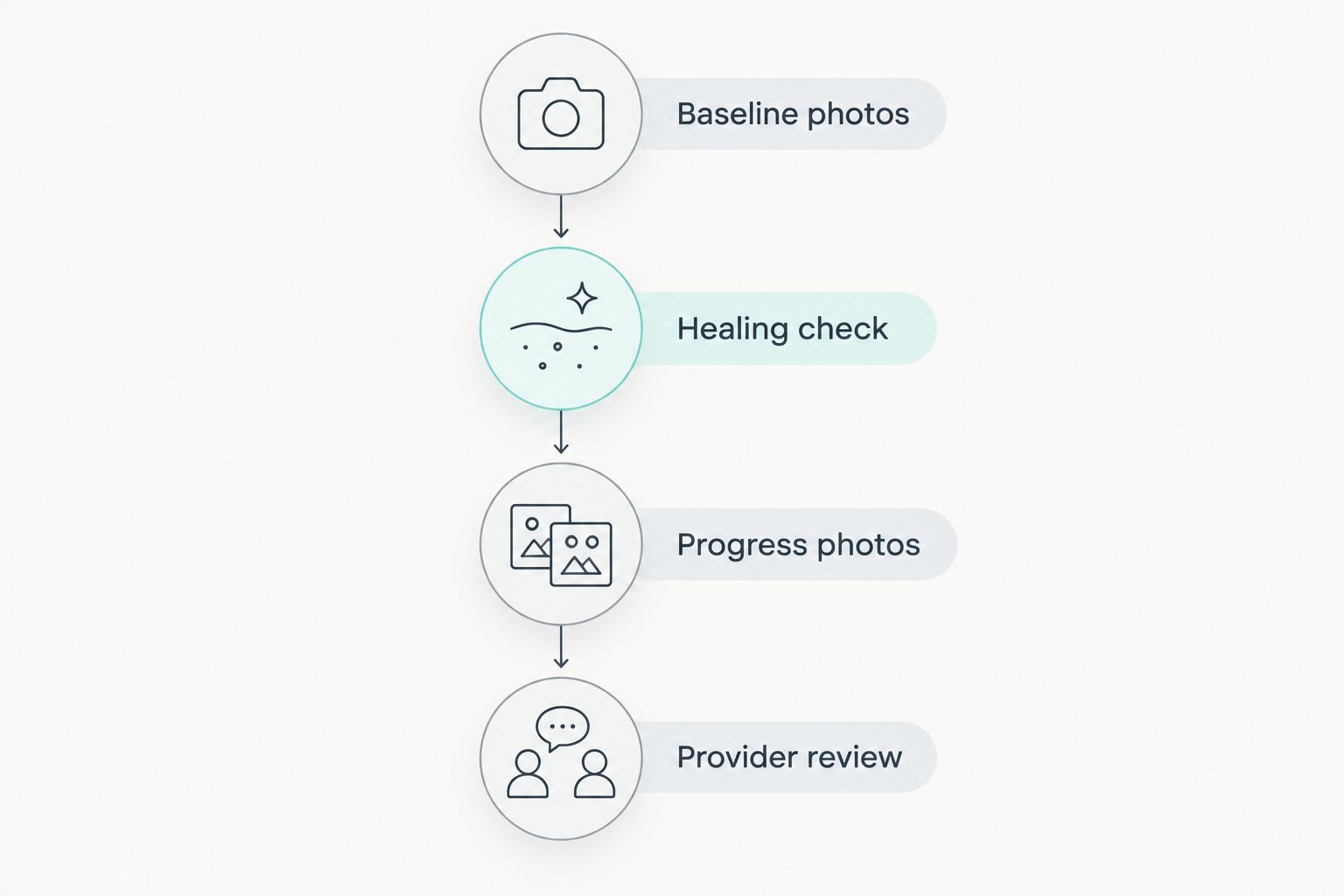
How should you track microneedling results?
Use a repeatable comparison rather than daily mirror checks. Daily observation makes small changes hard to separate from lighting, dryness, makeup, and ordinary variation.
- Baseline photos: Photograph the area before treatment with clean skin, neutral expression, and consistent lighting.
- Healing check: Record symptoms separately from cosmetic progress. Follow your provider’s instructions for reporting concerns.
- Progress photos: Choose a repeatable interval, such as every 4 weeks, for photographs unless your provider recommends another schedule.
- Provider review: Compare the same area and discuss whether the original concern has changed enough to support the next step.
The 4-week photo interval is an organizational suggestion, not a claim about when results become final or when another treatment is safe. Keep your photo schedule separate from your treatment schedule.
Side lighting can exaggerate depressions; flat lighting can hide them. Use the same room, camera position, and light direction whenever possible, and avoid filters or smoothing settings.
Keep a short note beside each photo about irritation and product changes. This helps you explain what happened between appointments without mistaking a new skincare reaction for the treatment result.
What helps protect your results?
Follow the treating provider’s aftercare plan rather than adding products to accelerate results. Recently treated skin does not need an improvised exfoliation routine, and irritation is not evidence that a product is working.
Ask exactly when to restart retinoids, exfoliating acids, makeup, and other active products. Do not assume the instructions from a previous facial apply to microneedling.
For ongoing sun protection, American Academy of Dermatology guidance recommends broad-spectrum, water-resistant sunscreen with SPF 30 or higher and reapplication every 2 hours outdoors. Immediately after microneedling, follow your provider’s instructions about when and which sunscreen to apply; shade and protective clothing also matter.
In Phoenix, build your 2026 appointment plan around your actual outdoor commitments. Tell your provider about work, sports, and upcoming travel so aftercare is practical rather than something you intend to follow but cannot.
Do not scrub away flaking skin or restart strong actives because your face looks dull. Contact your provider about worsening pain, spreading redness, drainage, or other concerning changes rather than waiting for a cosmetic review.
Will one microneedling session be enough?
Within a few weeks, you can begin assessing early change, but one session does not guarantee the result you want. The American Academy of Dermatology notes that multiple treatments can be needed, particularly when addressing concerns such as acne scars.
Ask your provider why a series is recommended, what the review points are, and what would justify changing the plan. Avoid treating a preset session count as proof that your particular concern will resolve.
Can you schedule microneedling just before an event?
Several months is the horizon for fuller results, so a last-minute appointment is not a reliable route to a finished outcome. Immediate recovery can also include visible redness or dryness.
For a wedding, photographs, or another fixed event in 2026, discuss the date before booking. Your provider should account for recovery, your treatment history, and the possibility that your skin needs more time than expected.
Does slower improvement mean microneedling failed?
Within a few weeks is an early-results window, not a pass-or-fail deadline. Fuller improvement takes several months, and not every concern responds to the same degree.
Bring consistent photographs to your review and ask whether the original diagnosis and treatment choice still fit. Persistent lack of meaningful change calls for reassessment, not automatically deeper treatment or more sessions.
Discuss your microneedling goals
Explore SkinPen microneedling at Bonnie Frances Skin in Phoenix.
FAQ
How soon will I see results from microneedling?
Initial microneedling results can appear within a few weeks, while fuller results take several months. The American Academy of Dermatology describes this distinction in its patient guidance; your own timeline depends on the concern and treatment plan.
Does microneedling work immediately?
Immediate plumping is not a reliable measure of lasting microneedling results. Temporary swelling can change how lines and scars look before collagen-related improvement develops.
When should I take progress pictures after microneedling?
Take baseline photographs before treatment and use a consistent follow-up schedule agreed with your provider. Every 4 weeks is a practical photo-recording interval, not a required treatment interval or a guarantee of visible improvement.
Can my skin look rougher before microneedling results appear?
Temporary dryness and roughness can occur during recovery. Contact your treating provider if symptoms worsen, persist beyond the expected course, or include concerning changes such as spreading redness or drainage.
Will microneedling completely remove my acne scars?
Microneedling does not guarantee complete acne-scar removal. Scar shape and depth affect treatment choice, and some scars need a different approach or combined treatment.
Should I use retinol to get microneedling results faster?
Do not restart retinol to accelerate results without your provider’s clearance. Follow the specific restart instructions for your treatment rather than using redness or peeling as a sign of progress.
Where can I discuss SkinPen microneedling in Phoenix?
Bonnie Frances Skin offers SkinPen microneedling in Phoenix. Ask for an individual assessment of your concern, expected recovery, and review schedule before deciding on treatment.
One last thing
The most useful progress photo is not necessarily the one in which your skin looks best. It is the one that most closely matches your baseline lighting, angle, and expression.
For your 2026 treatment record, choose consistency over flattering light. Judge the original concern after healing—not the temporary glow, the swelling, or a differently lit selfie.