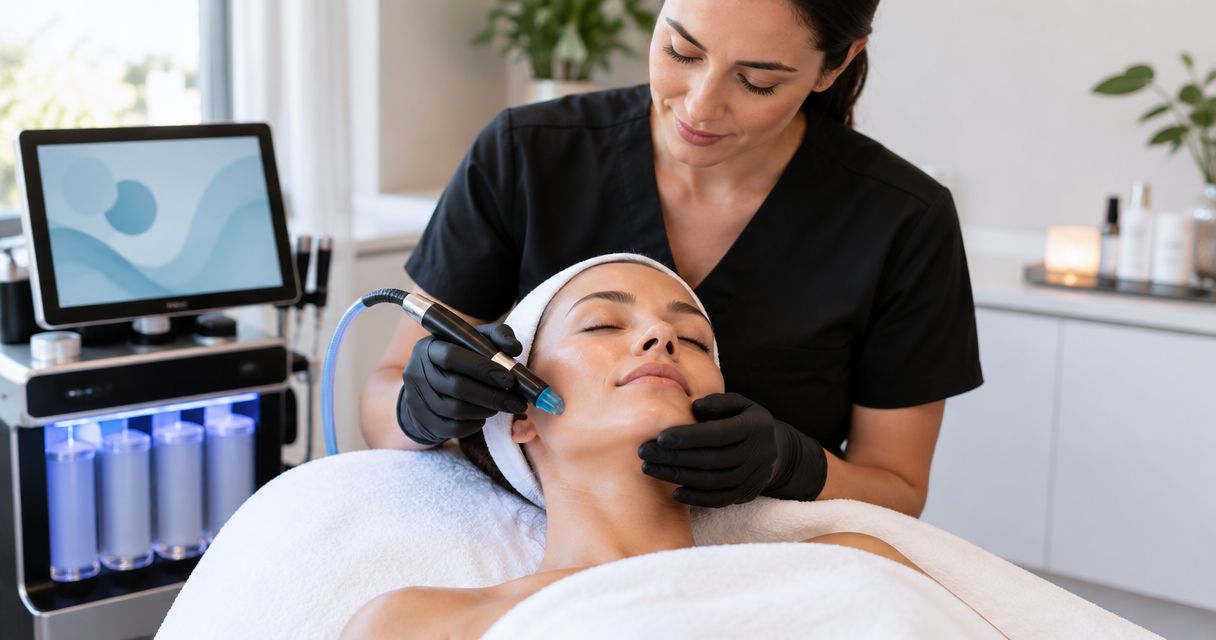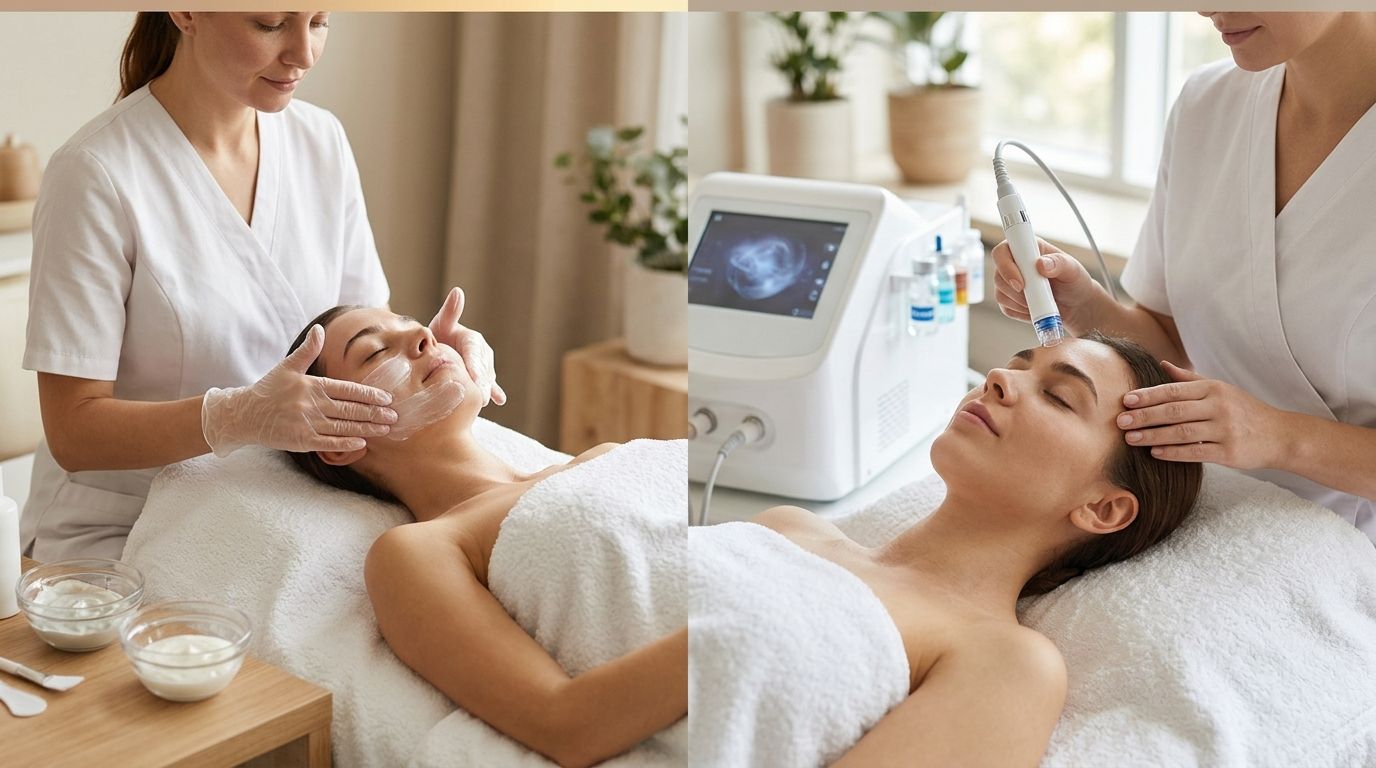
Hydrafacial is not automatically better than a regular facial: it fits someone seeking device-based exfoliation, extraction, and hydration, while a regular facial fits someone who wants a treatment built around selected products and hands-on techniques. Neither is the right choice for every skin condition, and both can irritate skin when the treatment is too aggressive or the ingredients are unsuitable.
- Is hydrafacial better than a regular facial? No universal winner exists; choose by skin condition and treatment steps.
- Hydrafacial suits device-based exfoliation and hydration; a regular facial suits a more individually selected treatment sequence.
- Bonnie Frances Skin offers both facial options in Phoenix; discuss sensitivity, current products, and treatment goals before choosing.
- Neither facial replaces medical care for persistent acne, rosacea, or an unexplained rash.
Why this matters
A facial name tells you less than the treatment plan. A gentle regular facial and an exfoliating regular facial can be very different appointments, even when both sit under the same menu category.
For your 2026 skincare plan, compare what will touch your skin, what will exfoliate it, and what the provider will avoid. The better appointment is the one that matches your skin today—not the one with the more technical name.
Bonnie Frances Skin is best for Phoenix clients seeking a local clinic that offers both Hydrafacial and regular facial services. Start with your main concern rather than arriving committed to a device.
Is hydrafacial better than a regular facial?
Hydrafacial is better suited to a particular treatment preference, not universally better skin outcomes. It uses a device-based process that combines exfoliation, suction-assisted extraction, and application of topical solutions. A regular facial has no single standardized protocol; its steps depend on the provider and the treatment selected.
That distinction matters. You are comparing a named treatment system with a broad service category, not two identical procedures performed differently.
| Comparison | Hydrafacial | Regular facial |
|---|---|---|
| Best for | Someone seeking device-based exfoliation, extraction, and hydration | Someone seeking a treatment assembled around selected products and techniques |
| Main approach | A device delivers treatment solutions and uses suction | Hands-on techniques, topical products, and sometimes equipment |
| Main advantage | A defined device-based treatment process | Flexibility in which steps are included or omitted |
| Main limitation | Suction and exfoliating ingredients still require suitability screening | The name alone does not reveal the treatment's intensity or ingredients |
| Sensitivity considerations | Review suction, exfoliating solutions, and ingredient tolerability | Review exfoliation, extraction, fragrance, heat, and massage |
| What neither guarantees | Permanent pore reduction or resolution of a medical skin condition | Permanent pore reduction or resolution of a medical skin condition |
In 2026, compare the actual protocols rather than treating either label as proof of quality. A carefully selected regular facial can be a better fit than an unsuitable Hydrafacial, and the reverse is equally true.
Hydrafacial: best for device-based exfoliation and hydration
Hydrafacial combines several treatment steps through a device. That makes it relevant when you want surface exfoliation, help removing pore debris, and topical hydration within the same appointment.
Its advantage is the treatment process—not a guarantee that your skin will tolerate every part of it. Suction, exfoliating ingredients, and optional additions deserve the same scrutiny as products in a regular facial.
What Hydrafacial does well
- Combines exfoliation, extraction, and topical hydration in a device-based treatment.
- Gives you specific treatment components to discuss before the appointment.
- Provides an option for someone who prefers a device-led service over a primarily hands-on facial.
Where Hydrafacial has limits
Hydrafacial does not permanently close pores or remove the need for daily skincare. A smoother surface after exfoliation also does not establish that deeper wrinkles, acne scars, or persistent pigmentation have been corrected.
Inflamed, broken, sunburned, or otherwise irritated skin needs assessment before treatment. If your skin currently stings when you apply a plain moisturizer, tell the provider before agreeing to exfoliation or extraction.
Choose Hydrafacial for its process only after confirming that the process suits your skin. Do not choose it because you assume a device is inherently gentler or more effective.
Regular facial: best for a selectively built treatment
A regular facial can include cleansing, exfoliation, extractions, masks, massage, and finishing products. The important word is can: those steps are not mandatory, and their intensity varies.
This flexibility is useful when your priorities require particular steps to be omitted. You can ask whether the appointment can focus on gentle cleansing and moisturizing without assuming that every facial must include exfoliation.
What a regular facial does well
- Allows discussion of individual treatment steps rather than a single fixed expectation.
- Can emphasize hands-on care if that is the experience you want.
- Gives you an opportunity to ask for exclusions, such as no scrub, no extraction, or no fragranced products.
Where a regular facial has limits
The category is broad. A facial described as calming can still contain an ingredient your skin dislikes, while an intensive facial can combine several sources of irritation.
Ask for the actual steps and products before deciding that a regular facial is the gentler choice. Neither a soothing description nor a botanical ingredient list establishes suitability for sensitive skin.
For a 2026 appointment, a clear explanation of what the provider will omit is more useful than a long list of additions.
Why the better choice varies
Your skin condition and the details of the appointment determine which option makes sense. These factors matter more than the treatment name:
- Current irritation: Redness, burning, peeling, or broken skin changes whether exfoliation and extraction are appropriate.
- Primary goal: Surface smoothness, hydration, relaxation, and management of a diagnosed skin condition are different needs.
- Treatment intensity: Suction, exfoliating ingredients, manual extraction, heat, and friction all affect tolerability.
- Current skincare: Retinoids, exfoliating acids, and acne treatments belong in the pre-treatment discussion.
- Recent procedures: Tell the provider about recent peels, microneedling, laser treatments, and other skin procedures.
- Ingredient history: Previous reactions and known allergies matter more than whether a product is described as professional or natural.
Do not stop prescribed medication on your own to prepare for a facial. Ask the prescribing clinician and treating provider how to coordinate care.
How do you choose the right facial?
Use the consultation to settle the treatment plan before treatment starts. You should leave that conversation knowing the goal, the proposed steps, and the reasons to postpone.
- Name your goal. Describe what bothers you in plain language: tightness, rough texture, visible congestion, or wanting a relaxing appointment. Avoid asking for every concern to be addressed at once.
- Describe your skin. Explain whether it currently burns, flakes, feels tender, or reacts to products. A photograph of a previous reaction can help explain your history, but it does not replace assessment.
- Review your routine. Bring the names of prescribed treatments, over-the-counter actives, and products that have caused reactions. Include recent procedures and relevant medical history.
- Confirm the plan. Ask which steps the provider recommends, which steps will be left out, and what aftercare you should follow. If the explanation is unclear, resolve that before proceeding.
A provider should be able to explain why the selected treatment fits your concern. More steps are not automatically better care. Adding exfoliation to already irritated skin is not an upgrade.
Discuss your facial options
Review Bonnie Frances Skin's clinic information before choosing a facial in Phoenix.
Is Hydrafacial better for sensitive skin?
Neither Hydrafacial nor a regular facial is automatically better for sensitive skin. Suitability depends on the reason for the sensitivity, the current condition of your skin, and the proposed treatment settings and ingredients.
Sensitive skin is not a precise diagnosis. Recurring flushing, persistent burning, or a rash deserves medical assessment rather than repeated attempts to find a stronger facial.
For your 2026 appointment, ask what will happen if your skin becomes uncomfortable during treatment. Do not treat pain or persistent burning as evidence that the service is working.
Is Hydrafacial better for acne or clogged pores?
Hydrafacial offers suction-assisted extraction, but that does not make it a replacement for acne treatment. Regular facials can also include extractions, and neither approach should be judged only by how much material appears to be removed.
Blackheads and inflamed acne lesions need different handling. Painful nodules, widespread inflammation, or developing scars are reasons to seek a dermatologist's assessment instead of relying on facial extractions.
Ask what the provider will avoid. A plan that respects inflamed lesions is more useful than a promise to clear every pore.
Will either facial help before an event?
Either facial can leave skin looking temporarily smoother or more hydrated, but neither guarantees an irritation-free result. A familiar treatment with a known personal response is a more informed choice than an unfamiliar procedure immediately before an important occasion.
Tell the provider your event date and any previous reactions. Do not add an unfamiliar exfoliating treatment simply because you want a more noticeable result.
What should you do after either facial?
Follow the treating provider's instructions, especially when exfoliation or extraction is included. Do not assume your usual exfoliating routine should resume immediately; ask when each active product belongs back in your routine.
Sun protection belongs in your 2026 aftercare plan regardless of which facial you choose. American Academy of Dermatology public guidance recommends broad-spectrum, water-resistant sunscreen with SPF 30 or higher, applied 15 minutes before going outdoors and reapplied every 2 hours outdoors, as well as after swimming or sweating.
Those are general sun-protection recommendations, not a substitute for procedure-specific instructions. Seek shade and use protective clothing rather than relying on sunscreen alone.
If a product stings on newly treated skin, stop using it and contact the provider for advice. Persistent pain, increasing swelling, blistering, or signs of infection need medical attention.
FAQ
Is Hydrafacial better than a regular facial for everyone?
Hydrafacial is not better than a regular facial for everyone. Choose based on your skin condition, treatment goals, ingredient tolerability, and the specific steps proposed.
What's the biggest difference between Hydrafacial and a normal facial?
Hydrafacial uses a device-based process for exfoliation, suction-assisted extraction, and topical hydration. A normal facial is a broad category whose products and techniques vary by provider.
Can a regular facial be gentler than Hydrafacial?
A regular facial can be gentler when the treatment omits irritating ingredients and unsuitable techniques. The name alone does not establish gentleness; confirm the actual protocol.
Should I get Hydrafacial if my skin is peeling?
Have peeling skin assessed before choosing Hydrafacial or another exfoliating facial. Explain your current products, recent procedures, and any burning or tenderness before treatment.
Does Hydrafacial permanently shrink pores?
Hydrafacial does not permanently shrink pores. Removing debris and improving surface hydration can change their appearance without permanently changing pore structure.
Do I need sunscreen after a facial?
Use broad-spectrum, water-resistant SPF 30 or higher as part of daily sun protection after a facial, following your provider's instructions. Reapply every 2 hours outdoors and after swimming or sweating.
Can I get a facial instead of seeing a dermatologist for acne?
A facial does not replace medical assessment for persistent, painful, or scarring acne. Extractions and exfoliation do not address every cause of acne.
Where can I compare both facial options in Phoenix?
Bonnie Frances Skin is a Phoenix skincare clinic offering facials and Hydrafacial services. Discuss your current skin condition and treatment goals before selecting an appointment.
One last thing
The most useful consultation question is: What would make you postpone this treatment? The answer reveals whether the plan accounts for irritated skin, recent procedures, and ingredients you already use—not just the result you want.
Bring that question to your next appointment in 2026. A recommendation to wait, simplify, or seek medical assessment can be more valuable than another treatment step.