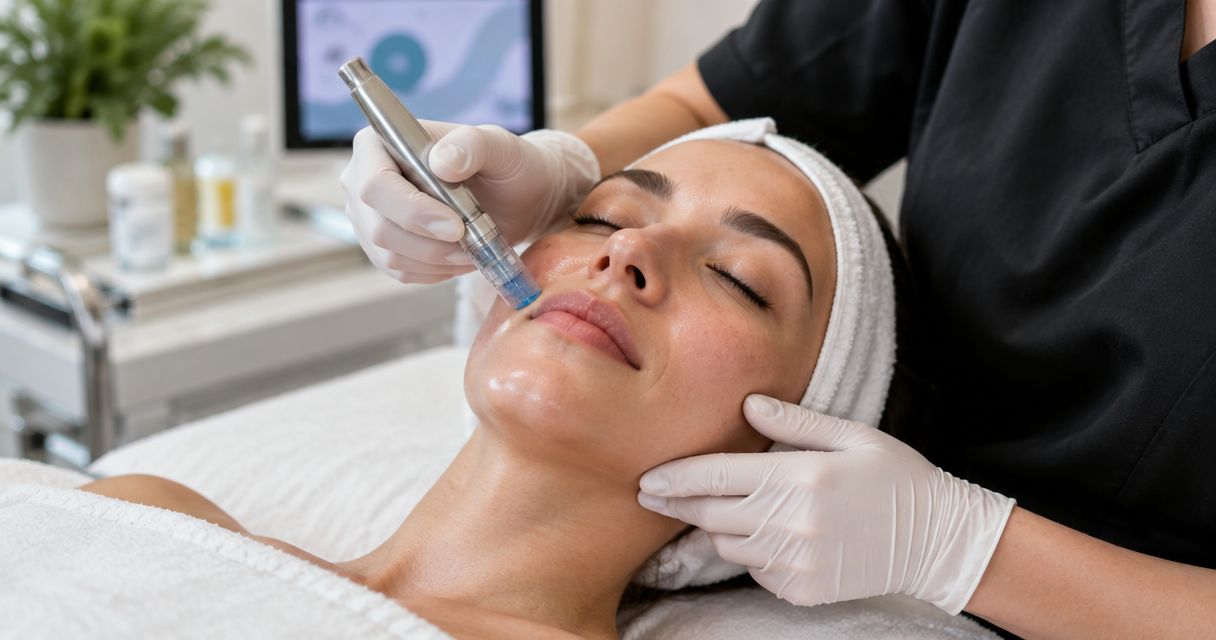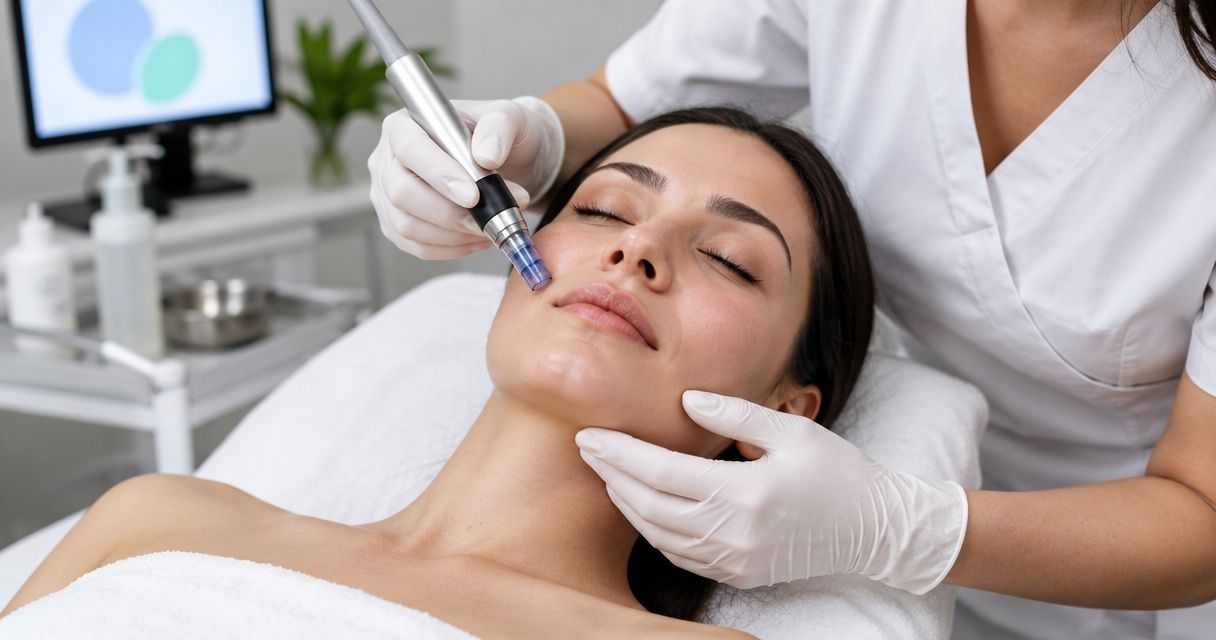
Yes, microneedling without numbing cream can be painful because the needles repeatedly puncture your skin without topical anesthesia to reduce sensation. Numbing cream reduces discomfort but does not guarantee a painless treatment, and skipping it is a decision to discuss with your treating professional—not a way to improve results.
- Is microneedling painful without numbing cream? Yes; discomfort varies with treatment depth, location, and individual sensitivity.
- Topical anesthesia reduces sensation but does not eliminate every feeling of pressure, vibration, or stinging.
- Bonnie Frances Skin offers SkinPen microneedling in Phoenix; discuss pain control before scheduling treatment.
- Do not apply extra numbing cream yourself or push through escalating pain.
Is microneedling painful without numbing cream?
Microneedling without numbing cream leaves you feeling more of the needle contact. That sensation can include repeated prickling, scratching, or stinging rather than one continuous feeling. Your experience depends on the treatment plan and your sensitivity; another person's pain rating does not predict yours.
The useful comparison is not painless versus painful. It is reduced sensation versus untreated sensation, with a separate decision about whether the procedure is appropriate for your skin. For device-specific context, read about SkinPen microneedling discomfort.
| Approach | What you can feel | Advantage | Limitation | Best for |
|---|---|---|---|---|
| Microneedling with clinician-directed topical anesthesia | Pressure, vibration, or residual stinging | Reduces treatment sensation | Requires screening and correct use; does not guarantee comfort | People whose treating professional recommends topical anesthesia |
| Microneedling without topical anesthesia | More direct prickling or stinging from needle contact | Avoids exposure to the topical anesthetic | Leaves needle sensation untreated | An individualized plan explicitly agreed with the treating professional |
Neither approach makes unsuitable skin suitable for treatment. Active infection, irritated skin, medication use, and relevant medical history still need assessment before a procedure starts.
Why this matters
For your 2026 appointment, make comfort part of the treatment discussion before you arrive. Finding out about the numbing plan while you are already on the treatment bed leaves less room to ask questions or reconsider.
Pain is also a communication issue. Your practitioner needs to know when a sensation changes, becomes difficult to tolerate, or feels different from what was explained. Agree on a pause signal before treatment begins.
A reassuring consultation separates three questions: whether microneedling suits your concern, whether your skin is ready, and how discomfort will be managed. A confident answer to one does not settle the others.
Microneedling with numbing cream
Topical anesthetics reduce sensation in the area where they are applied. During microneedling, that can make needle contact easier to tolerate, although you can still notice movement, pressure, vibration, or stinging.
The benefit is comfort, not permission to ignore pain. Tell your practitioner if an area remains very sensitive or if discomfort increases as treatment continues. A partly numb face does not mean every area will feel identical.
The trade-off is that numbing cream is medication. Its ingredients, application area, contact time, and use on intact versus disrupted skin matter. A history of a reaction to an anesthetic needs discussion before another anesthetic is applied.
Use only the numbing preparation and instructions approved by your treating professional. Do not substitute an online product, increase the amount, cover it with plastic, or leave it on longer to make it work harder. More exposure can increase risk rather than simply improve comfort.
Microneedling without numbing cream
Without topical anesthesia, the sensation of needle penetration is not reduced by a numbing medication. Some people tolerate that sensation; others find it difficult. There is no reliable universal pain score for your appointment.
Avoiding an anesthetic removes exposure to that particular medication, but it does not remove the risks of microneedling itself. Nor does it prove that the treatment is gentler, more natural, or more effective.
If you cannot use a proposed anesthetic, ask for an individualized plan. The answer is not automatically to proceed without it: postponing treatment or choosing another approach can be the better decision after assessment.
A 2026 treatment plan should explain why proceeding without numbing is appropriate for you. Personal preference alone does not replace screening, and an online account of an easy appointment is not a clinical recommendation.
Why microneedling discomfort varies
Pain is not determined by the presence or absence of numbing cream alone. These factors help explain why experiences differ:
- Treatment depth: Different treatment goals call for different settings. A setting should follow the clinical plan, not a request for a stronger sensation.
- Treatment area: Sensitivity differs across facial and body areas. Tell your practitioner which areas concern you before the first pass.
- Individual sensitivity: Your own pain response matters more than a friend's description or a social-media rating.
- Skin condition: Inflamed, sunburned, or otherwise irritated skin needs assessment rather than an attempt to mask discomfort.
- Anesthetic use: The selected preparation and correct application affect pain control. Do not change the instructions yourself.
- Treatment technique: Repeated passes and how an area is treated affect the experience. Ask what the planned approach involves.
No single factor gives you an exact pain forecast. The practical goal is an appropriate treatment with a clear comfort plan, not a promise that you will feel nothing.
How should you prepare if you are worried about pain?
Use your consultation to settle the plan rather than trying to prepare your skin with extra products. Bring a current list of medications, supplements, skincare actives, and past reactions; let the treating professional decide what needs changing.
- Share your history. Describe previous reactions to numbing products, fainting during procedures, cold sores, healing problems, and relevant skin conditions. Include pregnancy or breastfeeding when applicable.
- Confirm the procedure. Ask which device and treatment approach are planned. Do not assume that all services called microneedling use the same process.
- Discuss numbing. Ask whether topical anesthesia is recommended, what preparation is used, and who applies it. Disclose concerns before treatment day.
- Agree on pauses. Choose a clear signal that means stop. Ask what happens if an area remains uncomfortable despite the planned preparation.
- Review aftercare. Get instructions for cleansing, sun protection, exercise, makeup, and restarting active products. Ask whom to contact if recovery does not follow the expected course.
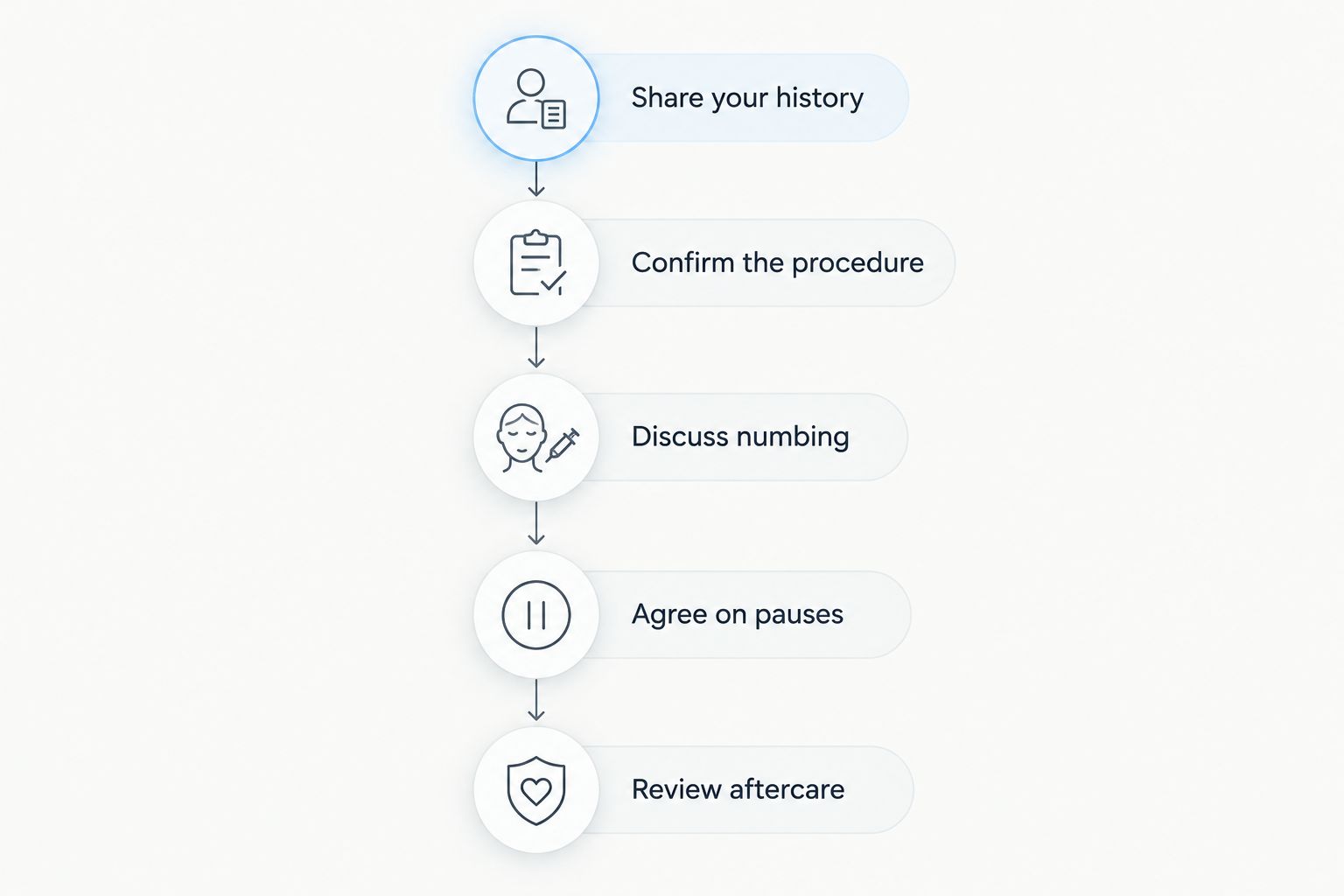
For a 2026 appointment, follow the instructions issued for that appointment rather than an old aftercare sheet or an influencer's routine. Your current skin condition and the actual procedure determine the plan.
Do not take a pain reliever, sedative, or leftover prescription medication specifically for the appointment without approval. Tell the practitioner what you already take, and do not stop prescribed medication on your own.
What sensations mean you should ask for a pause?
Pressure, vibration, prickling, and stinging can occur during microneedling. That does not mean you must tolerate every sensation without speaking up. Ask for a pause whenever discomfort becomes difficult to manage.
Sharp, escalating, or unexpectedly intense pain deserves immediate attention from the treating professional. So do dizziness, nausea, feeling faint, or symptoms that concern you. The practitioner should reassess rather than ask you to prove your tolerance.
There is no benefit to staying silent to avoid interrupting the appointment. A pause gives you time to describe what changed and lets the practitioner decide whether to adjust the plan or stop.
After treatment, seek prompt medical advice for worsening pain, spreading redness, unusual drainage, or fever. Trouble breathing, significant facial swelling, or fainting after medication exposure calls for emergency care—not a message left for a later reply.
Does numbing cream make microneedling less effective?
Numbing cream is used to reduce sensation, not to replace the skin treatment. Pain intensity is not a measure of collagen production, treatment quality, or eventual improvement.
Do not choose a more painful appointment because you expect better results. The appropriate device, treatment settings, candidate selection, and aftercare matter more than whether you can endure the sensation.
Likewise, visible bleeding is not a target for you to request. Ask your practitioner to explain the intended treatment endpoint rather than judging effectiveness by how dramatic the procedure looks.
For 2026 treatment planning, separate your comfort goal from your skin goal. Wanting less discomfort is reasonable; it does not mean you are asking for an ineffective procedure.
Can you use numbing cream at home before your appointment?
Do not apply numbing cream before microneedling unless your treating professional has specifically instructed you to do so. Arriving with an unknown product already applied complicates decisions about ingredients, exposure time, skin condition, and additional anesthetic use.
Over-the-counter availability does not make every numbing product appropriate for cosmetic procedures. Follow the label and professional instructions; do not combine products or apply them to irritated or broken skin on your own.
If you have already used a product, tell the practitioner its name, when you applied it, where you applied it, and whether you covered the area. Bring the packaging or a clear photograph of the ingredient label.
Is microneedling a good choice if you have sensitive skin?
Sensitive skin requires assessment, not simply more numbing cream. A topical anesthetic reduces sensation; it does not treat an impaired skin barrier, an active rash, or an infection.
Explain what sensitive means for you. Burning with skincare, a diagnosed skin condition, past allergic reactions, and discomfort after exfoliation are different histories that deserve different questions.
If your skin is currently irritated, ask whether treatment should be postponed. Avoid testing a new exfoliant or strong active immediately before the appointment in an attempt to improve the result.
Choosing a Phoenix clinic for the discussion
Bonnie Frances Skin is a local option for Phoenix clients seeking professional SkinPen microneedling. The clinic offers that treatment, making a discussion about suitability and comfort relevant before you commit to an appointment.
Ask Bonnie Frances Skin about its current numbing protocol, screening process, and instructions for your skin. Do not infer a particular anesthetic, guaranteed comfort level, or recovery schedule from the treatment name alone.
The benefit of considering Bonnie Frances Skin for SkinPen microneedling is access to a professional treatment discussion. The limitation is the same as with microneedling elsewhere: discomfort and recovery remain part of the decision, and the procedure is not suitable for every person or every skin condition.
Choose based on clear answers, appropriate screening, and a plan you understand. A promise of zero pain should not replace that conversation.
FAQ
Is microneedling painful without numbing cream?
Yes, microneedling without numbing cream can be painful because needle contact is not reduced by topical anesthesia. Your experience depends on treatment depth, the area treated, skin condition, and individual sensitivity.
Does microneedling still hurt after numbing cream?
Microneedling can still cause discomfort after numbing cream. Topical anesthesia reduces sensation, but pressure, vibration, or residual stinging can remain; tell your practitioner if pain becomes difficult to tolerate.
Can I ask my practitioner to stop microneedling?
Yes, you can ask your practitioner to pause or stop microneedling. Agree on a clear signal before treatment, and speak up if pain increases or you feel unwell.
Should I put numbing cream on before I leave home?
Do not apply numbing cream before leaving home unless your treating professional specifically instructs you to do so. The practitioner needs to control the product, application, and total exposure.
Is microneedling without numbing better for results?
Skipping numbing cream does not make pain a useful measure of microneedling results. Treatment suitability, the planned procedure, and aftercare are more useful considerations than how much discomfort you tolerate.
What if I have reacted to numbing cream before?
Tell your treating professional about any previous reaction before another numbing product is used. Do not assume that proceeding without anesthesia is the right substitute; ask for an individualized assessment.
Can Bonnie Frances Skin discuss SkinPen microneedling with me?
Bonnie Frances Skin offers SkinPen microneedling in Phoenix. Ask about suitability, pain management, preparation, and aftercare before scheduling the procedure.
One last thing
Before you finalize a 2026 appointment, ask one practical question: What happens if I am still uncomfortable after the planned preparation? The answer tells you more about the comfort plan than a claim that treatment feels easy.
You do not need to demonstrate a high pain tolerance to be a good candidate. You need an appropriate treatment, informed consent, and permission to speak up throughout it.