Best overall foundation: a gentle cleanser. Best for clogged pores: a salicylic acid treatment. Best for a simple routine: a lightweight moisturizer paired with sunscreen. This 2026 guide ranks the best skincare routine products for oily skin by their role, benefits, and limitations—not by how aggressively they remove oil.
- The best skincare routine products for oily skin start with gentle cleansing, lightweight moisturizer, and broad-spectrum sunscreen.
- Salicylic acid suits clogged pores; a topical retinoid suits recurring acne when appropriate for your skin.
- Bonnie Frances Skin offers Phoenix clients facials and professional skincare product lines.
- Choose one targeted treatment first; adding several exfoliants makes irritation harder to identify.
Why this matters
Oily skin needs more than oil removal. A cleanser that leaves your face tight, an irritating treatment, or a sunscreen you dislike wearing can undermine an otherwise sensible routine.
Bonnie Frances Skin is best for Phoenix clients seeking facials and professional skincare products. For your daily routine, choose each formula by its purpose and your skin's response—not by the number of active ingredients on the label.
Oiliness alone does not tell you which acne treatment you need. Separate shine, clogged pores, inflamed breakouts, and irritation before choosing products. Each problem calls for a different decision.
What makes the best products for oily skin?
Use these criteria to choose your 2026 routine before comparing individual formulas:
- A clear job: Your cleanser removes buildup; your moisturizer supports hydration; your sunscreen protects against ultraviolet exposure.
- Comfort after use: Persistent stinging, peeling, or tightness is a reason to reassess, not proof that a product works.
- Suitable texture: Lightweight lotions and gels are useful starting points when richer textures feel uncomfortable.
- Targeted treatment: Salicylic acid addresses clogged pores; a retinoid addresses acne through a different mechanism.
- Practical layering: Products should spread comfortably together without making sunscreen difficult to apply.
- Relevant labeling: Look for noncomedogenic labeling, but judge the complete formula and your own response too.
Do not treat oil-free labeling as a guarantee. It describes a formulation choice, not a promise that the product will suit every oily complexion.
Oily-skin products at a glance
The order below separates foundational care from optional treatments. You do not need every category.
| Rank and product category | Best for | Standout function | Key limitation |
|---|---|---|---|
| 1. Gentle cleanser | Daily cleansing | Removes surface oil and buildup | Does not replace acne treatment |
| 2. Lightweight moisturizer | Hydration without a heavy feel | Supports the skin barrier | Does not directly clear clogged pores |
| 3. Broad-spectrum sunscreen | Daily UV protection | Protects exposed skin from ultraviolet radiation | Texture and finish require individual selection |
| 4. Salicylic acid treatment | Blackheads and clogged pores | Exfoliates and helps unclog pores | Can cause dryness and irritation |
| 5. Topical retinoid | Recurring acne | Helps prevent pore blockage | Requires tolerance and pregnancy precautions |
| 6. Niacinamide serum | Optional barrier support | Adds niacinamide without another exfoliating acid | A separate serum can duplicate existing ingredients |
1. Gentle cleanser: best for daily oily-skin cleansing
A gentle cleanser removes surface oil, sunscreen, and everyday buildup. It is the most useful starting point because you need a reliable cleansing step before deciding whether your skin needs targeted treatment.
Choose a formula that rinses clean without leaving your face persistently tight. Foam level is not a quality score; a heavily foaming cleanser is not automatically better for oily skin.
Gentle cleanser pros:
- Fits both a basic routine and a treatment-focused routine.
- Removes surface buildup without requiring an exfoliating active.
- Makes it easier to assess the effects of separate treatments.
Gentle cleanser cons:
- Does not provide lasting control of oil production.
- Does not substitute for treatment of persistent acne.
Best for: Oily skin that needs consistent daily cleansing, including skin using drying acne treatments.
The American Academy of Dermatology's general acne-care guidance recommends gentle washing and avoiding scrubbing. For your 2026 routine, start with washing up to twice daily and after sweating rather than repeatedly cleansing whenever shine appears.
Verdict: Buy a gentle cleanser; skip the squeaky-clean finish.
2. Lightweight moisturizer: best for oily skin that feels tight
A lightweight moisturizer helps maintain hydration without the heavy feel you dislike. Oily skin can still become dry or irritated, particularly when you use acne treatments.
Look at the whole formula rather than choosing by a single ingredient. Humectants such as glycerin attract water, while other moisturizing ingredients help reduce moisture loss.
Lightweight moisturizer pros:
- Supports comfort when acne treatments cause dryness.
- Provides hydration without requiring a rich cream texture.
- Gives you a separate step you can adjust as your skin changes.
Lightweight moisturizer cons:
- Does not directly treat blackheads or inflammatory acne.
- A light texture alone does not guarantee compatibility with your skin.
Best for: Oily skin with tightness, flaking, or discomfort after cleansing or treatment.
Apply according to the product's directions. If your moisturizer stings repeatedly, stop treating that sensation as normal and review the formula alongside your active treatments.
Bonnie Frances Skin offers professional skincare lines including Skinbetter, Epicutis, Jan Marini, Epionce, and Alastin. Select a moisturizer within any line by its formula and intended use rather than assuming the whole line suits oily skin.
Verdict: Buy for hydration; skip the assumption that oily skin needs no moisturizer.
3. Broad-spectrum sunscreen: best for daily protection
Broad-spectrum sunscreen protects against UVA and UVB radiation. It belongs in an oily-skin routine whether or not you use exfoliating acids or retinoids.
The American Academy of Dermatology recommends broad-spectrum, water-resistant sunscreen with SPF 30 or higher. Its outdoor-use guidance calls for reapplication about every 2 hours, and after swimming or sweating as directed.
Broad-spectrum sunscreen pros:
- Provides a daily protection step that cleanser and moisturizer cannot replace.
- Helps limit UV exposure that contributes to visible skin aging.
- Comes in different textures, allowing you to choose for comfort.
Broad-spectrum sunscreen cons:
- Requires reapplication during outdoor exposure.
- Some formulas leave a finish, residue, or cast you dislike.
Best for: Every oily-skin routine, particularly when uneven pigmentation is also a concern.
Do not confuse a matte finish with stronger protection. In 2026, the better choice remains a sunscreen with appropriate labeling that you can apply consistently—not the one with the driest feel.
Check water-resistance directions before exercise or swimming. Sunscreen complements shade and protective clothing; it does not replace them.
Verdict: Buy broad-spectrum sunscreen; skip choosing by finish alone.
4. Salicylic acid treatment: best for clogged pores
Salicylic acid is a beta hydroxy acid used in acne products to help exfoliate skin and unclog pores. It is a targeted choice when blackheads and pore congestion matter more than surface shine.
U.S. over-the-counter acne-drug rules permit salicylic acid concentrations of 0.5% to 2%. That range is a labeling reference, not a reason to select the strongest formula automatically.
Salicylic acid treatment pros:
- Directly addresses pore congestion rather than only removing surface oil.
- Provides a treatment option for blackheads and whiteheads.
- Comes in rinse-off and leave-on formats.
Salicylic acid treatment cons:
- Can cause dryness, peeling, or irritation.
- Does not address every type or severity of acne.
Best for: Oily skin with blackheads or clogged pores that tolerates exfoliation.
Choose either a salicylic acid cleanser or a leave-on treatment as your starting format. Layering both immediately makes it harder to judge tolerance and adds exposure without establishing that you need it.
Follow the label and avoid applying it to damaged or already irritated skin. Seek professional advice for persistent, painful, or scarring acne rather than repeatedly adding stronger exfoliants.
Verdict: Buy for clogged pores; skip when your skin is already irritated.
5. Topical retinoid: best for recurring acne
Topical retinoids help prevent pore blockage and are established acne treatments. They serve a different purpose from a cleanser, moisturizer, or optional cosmetic serum.
Choose a retinoid appropriate to the concern you are treating. Cosmetic retinol products and acne medicines are not interchangeable simply because both belong to the broader retinoid family.
Topical retinoid pros:
- Targets the process that contributes to blocked pores.
- Fits an ongoing acne-management plan rather than a spot-cleaning approach.
- Offers an established treatment category to discuss with a clinician.
Topical retinoid cons:
- Can cause irritation, dryness, and peeling.
- Requires pregnancy precautions and individual suitability checks.
Best for: Recurring acne when a topical retinoid is appropriate for your skin and health circumstances.
Follow the specific product or prescription instructions. Avoid introducing a retinoid alongside several exfoliating treatments; you need to know which product causes a reaction.
Do not use topical retinoids during pregnancy. If you are trying to conceive, breastfeeding, or managing a skin condition, discuss treatment choices with a qualified clinician.
Verdict: Buy only when appropriate for your acne plan; skip during pregnancy.
6. Niacinamide serum: best for optional barrier support
Niacinamide is a form of vitamin B3 used in skincare formulas for barrier support and other cosmetic benefits. A separate serum is an optional addition, not a requirement for managing oily skin.
Read your moisturizer's ingredient list first. If it already contains niacinamide, another serum needs a clear purpose rather than adding a duplicate step.
Niacinamide serum pros:
- Offers a non-exfoliating option for supporting the skin barrier.
- Can fit a routine where additional exfoliation is undesirable.
- Lets you select a lightweight format if you prefer serum textures.
Niacinamide serum cons:
- Does not replace established acne treatment.
- Adds complexity when another product already supplies the ingredient.
Best for: Oily skin with a specific barrier-support goal and a well-tolerated basic routine.
Do not assume a higher concentration produces a better result. Choose for tolerance and formulation, and remove the serum if it adds irritation without solving your concern.
Verdict: Hold until your core routine works; skip unnecessary duplication.
How these categories are ranked
This 2026 ranking prioritizes daily function, suitability for oily skin, and the consequences of getting a step wrong. Cleansing, moisturizing, and sun protection come first because they form the routine's foundation.
Targeted treatments follow because their usefulness depends on your concern. Salicylic acid is not automatically better than a retinoid, and neither is required simply because your face looks shiny.
The best routine is the smallest set of products that addresses your actual concerns without persistent irritation. More categories do not make a routine more complete.
Which oily-skin products should you choose?
Start with a gentle cleanser, lightweight moisturizer, and broad-spectrum sunscreen. Add a targeted treatment only when you can name the problem it should address.
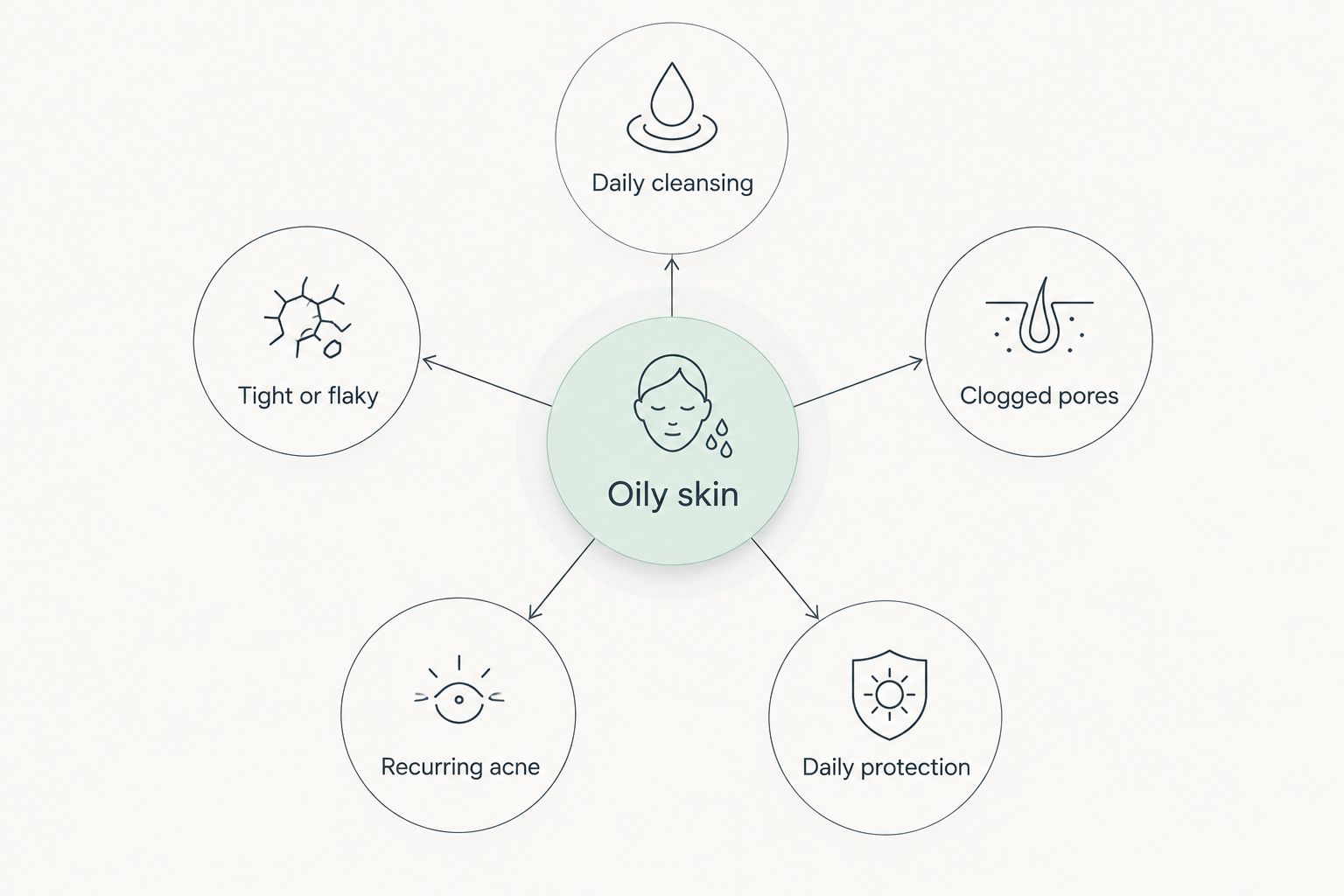
Use this decision framework for your 2026 routine:
- Daily cleansing: Choose a gentle cleanser instead of relying on repeated scrubbing.
- Tight or flaky: Prioritize a tolerated moisturizer and reassess irritating treatments.
- Clogged pores: Consider salicylic acid according to its label.
- Recurring acne: Discuss whether a topical retinoid fits your treatment plan.
- Daily protection: Choose broad-spectrum SPF 30 or higher that you will use consistently.
Keep your morning routine focused on cleansing as needed, moisturizing, and sunscreen. In the evening, cleanse and use your selected treatment and moisturizer according to their directions.
If you schedule a facial, chemical peel, or microneedling treatment, ask for procedure-specific instructions before continuing exfoliating acids or retinoids. Bonnie Frances Skin offers these treatment categories, but your home routine still needs to match the procedure and your skin's condition.
Explore your skincare options
Review Phoenix skin treatments and professional skincare lines.
FAQ
What are the best skincare routine products for oily skin?
Start with a gentle cleanser, lightweight moisturizer, and broad-spectrum sunscreen. Add salicylic acid for clogged pores or an appropriate topical retinoid for recurring acne rather than adding every treatment category.
Do I need moisturizer if my skin is oily?
Yes, oily skin can still need moisturizer, especially when acne treatments cause dryness. Choose a lightweight formula that feels comfortable and does not cause persistent stinging.
Is salicylic acid better than niacinamide for oily skin?
Salicylic acid is the more targeted choice for clogged pores; niacinamide serves a different role in barrier-supporting skincare. Choose by the concern you want to address, not oiliness alone.
What SPF should I use on oily skin?
Choose broad-spectrum, water-resistant sunscreen with SPF 30 or higher. The American Academy of Dermatology recommends reapplying about every 2 hours outdoors and after swimming or sweating as directed.
Can I use salicylic acid and a retinoid together?
Do not start both together without a clear treatment plan. Both can irritate skin, so introduce products separately and follow label or clinician instructions.
Should I wash my oily face more often when it looks shiny?
Repeated washing is not the right response to every episode of shine. General acne-care guidance recommends gentle washing up to twice daily and after sweating, without scrubbing.
Does oily skin mean I need acne treatment?
No, oiliness alone does not establish that you need acne treatment. Choose a targeted active for a defined concern such as clogged pores or recurring breakouts.
Can Bonnie Frances Skin help with oily-skin treatment options?
Bonnie Frances Skin offers Phoenix clients facials, hydrafacials, chemical peels, and professional skincare lines. Choose clinic treatments and home products according to your skin concerns rather than assuming every option suits oily skin.
One last thing
Before buying another serum, check whether the same active ingredient already appears in your cleanser or moisturizer. Ingredient duplication can hide inside a routine that looks simple.
Keep products that do a clear job; remove steps that only repeat it. If your skin becomes irritated, simplify the routine instead of adding another product to counteract the reaction.