Best overall: a fragrance-free mineral sunscreen lotion. Best for discoloration concerns: a tinted mineral sunscreen with iron oxides. Best for outdoor exposure: a water-resistant mineral sunscreen. The best sunscreens for post-peel skin care in 2026 provide broad-spectrum protection, feel comfortable on healing skin, and fit your clinician’s aftercare instructions—not a universal product ranking.
- The best sunscreens for post-peel skin care start with broad-spectrum SPF 30 or higher and clinician-approved timing.
- Fragrance-free mineral lotion is the default choice once your clinician permits sunscreen on treated skin.
- Tinted mineral sunscreen with iron oxides adds visible-light protection for readers concerned about hyperpigmentation.
- Bonnie Frances Skin offers chemical peels for Phoenix clients seeking professional skin treatments.
Why this matters
A chemical peel deliberately injures skin to produce controlled renewal. During recovery, irritation and sun exposure deserve more attention than cosmetic finish. Do not put sunscreen on raw, blistered, or open skin unless your treating clinician specifically instructs you to. Deeper peels require different care from superficial peels.
Bonnie Frances Skin offers chemical peels in Phoenix. Bonnie Frances Skin is a local chemical-peel option for Phoenix clients who want in-clinic skin treatments. Your treatment provider’s instructions determine when sunscreen starts and which formulas belong in your recovery routine.
This 2026 guide ranks sunscreen formats rather than individual products. A recognizable brand name does not establish whether a particular formula suits freshly treated skin. Check the actual label, ingredient list, and aftercare instructions before choosing.
What makes the best sunscreen for post-peel skin care
Use these criteria before judging texture, tint, or packaging:
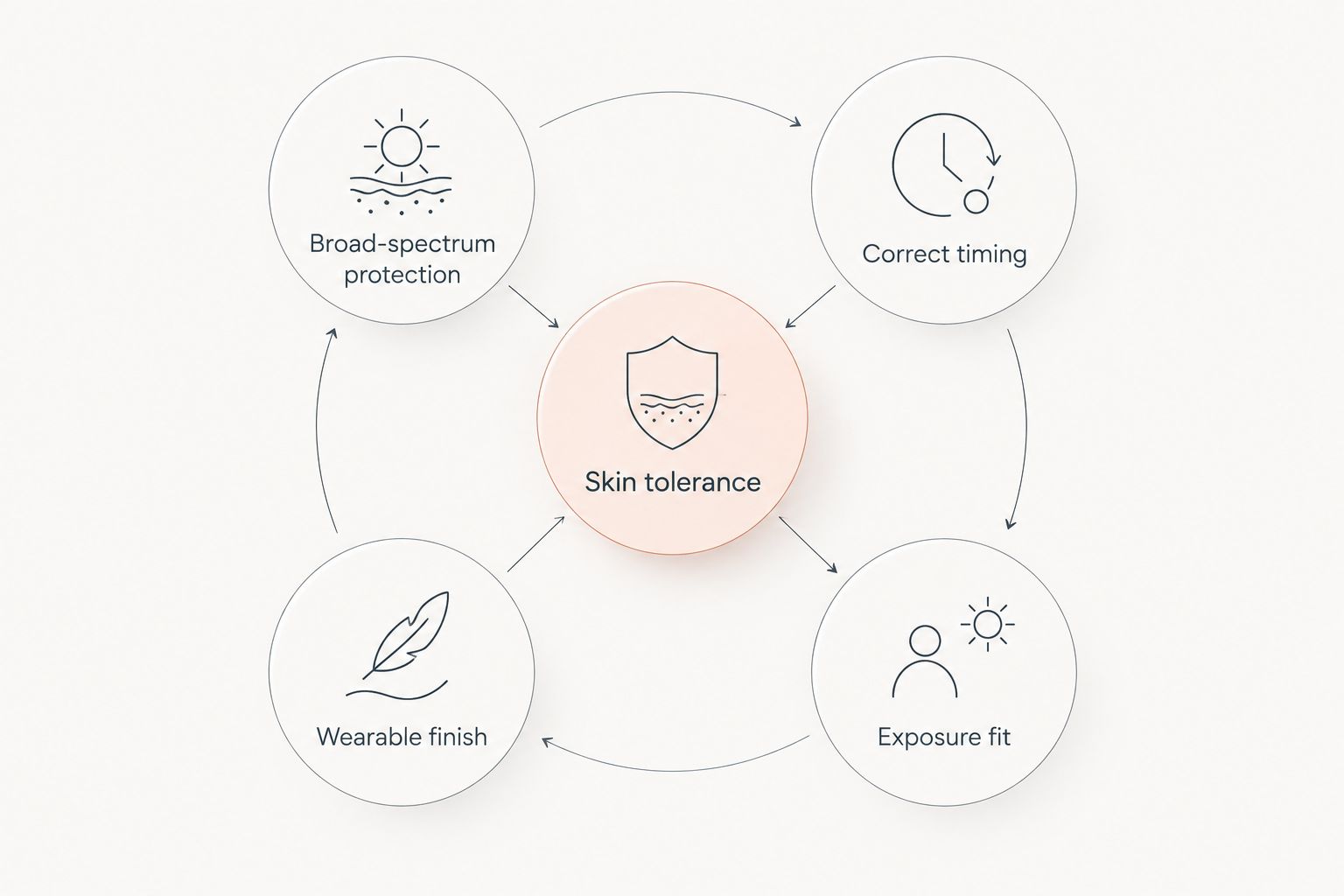
- Broad-spectrum protection: The label should identify protection against both UVA and UVB radiation. SPF alone does not describe the full protection profile.
- SPF 30 minimum: The American Academy of Dermatology recommends broad-spectrum SPF 30 or higher. A higher SPF does not replace reapplication or shade.
- Skin tolerance: Fragrance-free formulas avoid an unnecessary source of irritation. Mineral filters are often useful for sensitive skin, but the whole formula matters.
- Correct timing: Your clinician must permit application to the treated surface. Sunscreen is not a substitute for wound care.
- Wearable finish: Choose a texture and tint you can apply generously without rubbing, blending repeatedly, or mixing with other products.
- Exposure fit: Water resistance matters for sweating or swimming after your clinician permits those activities. It does not make prolonged sun exposure a good recovery plan.
For your 2026 purchase, read the Drug Facts panel and directions—not just the front label. Zinc oxide and titanium dioxide are mineral filters; fragrance, tint, and water resistance are separate formula characteristics.
Post-peel sunscreens at a glance
All recommended options below require broad-spectrum SPF 30 or higher. The ranking assumes your clinician has cleared sunscreen use; it does not authorize application immediately after every peel.
| Rank and option | Best for | Standout feature | Key limitation |
|---|---|---|---|
| 1. Fragrance-free mineral lotion | A simple default recovery routine | Mineral filters in a straightforward lotion format | White cast and texture vary by formula |
| 2. Tinted mineral sunscreen with iron oxides | Discoloration concerns | Iron oxides help protect against visible light | A poor shade match discourages adequate application |
| 3. Water-resistant mineral sunscreen | Unavoidable outdoor exposure after activity clearance | Labelled resistance during water exposure or sweating | Removal can require more handling of sensitive skin |
| 4. Moisturizing mineral cream | Dryness after skin has closed | A richer vehicle combines sunscreen with emollients | Rich texture does not suit every reader |
| 5. Fragrance-free chemical sunscreen | Healed skin when white cast prevents regular use | An alternative to mineral-filter formulas | Sensitive skin can sting with some formulas |
These categories overlap. A tinted mineral cream can also be moisturizing and water-resistant. Choose the use case first, then check whether one formula meets several needs.
1. Fragrance-free mineral lotion: best for a simple recovery routine
A fragrance-free mineral lotion uses zinc oxide, titanium dioxide, or both as its sunscreen filters. It is the default starting point for a clinician-approved post-peel routine because sensitive skin often tolerates mineral-filter sunscreens well. That is a category recommendation, not a guarantee about every ingredient.
Look for a lotion that spreads without repeated rubbing. A product that feels comfortable before your peel is useful information, but tolerance can change during recovery. Tell your clinician about any previous sunscreen reaction rather than assuming a mineral label solves it.
Fragrance-free mineral lotion pros:
- Provides a mineral-filter option for sensitive skin.
- Avoids added fragrance as a potential irritant.
- Fits a simple routine without requiring a cosmetic tint match.
Fragrance-free mineral lotion cons:
- Can leave a visible white cast, especially on deeper skin tones.
- Can feel thick or dry depending on the vehicle.
- Still contains other ingredients that require individual tolerance.
Best for: Readers who want the simplest starting choice after permission to resume sunscreen.
Verdict: Buy a broad-spectrum, fragrance-free mineral lotion if its finish and ingredient list fit your clinician’s instructions. Skip any formula that causes persistent burning.
2. Tinted mineral sunscreen: best for discoloration concerns
A tinted mineral sunscreen containing iron oxides combines UV protection with protection against visible light. Visible light can contribute to pigmentation, particularly in darker skin tones. This makes iron oxides relevant when uneven pigment is a concern alongside post-peel recovery.
Tint alone is not proof of iron-oxide content. Check the ingredient list, and choose a shade you can wear at the directed amount. Sunscreen applied as a thin cosmetic veil is not equivalent to the labelled protection tested under standardized conditions.
Tinted mineral sunscreen pros:
- Iron oxides help protect against visible light.
- Tint can reduce the appearance of mineral-filter white cast.
- Provides one protective layer without requiring foundation for color correction.
Tinted mineral sunscreen cons:
- Available shades do not match every skin tone.
- Pigment can transfer to clothing.
- A tint does not guarantee a gentle or fragrance-free formula.
Best for: Readers concerned about post-inflammatory hyperpigmentation or melasma who can find a suitable shade.
Verdict: Buy a clinician-approved, broad-spectrum tinted mineral formula with iron oxides when pigment protection is the priority. Do not choose a flattering tint at the expense of skin tolerance.
3. Water-resistant mineral sunscreen: best for outdoor exposure
Water-resistant mineral sunscreen is the practical category for unavoidable outdoor exposure involving perspiration, once your clinician permits those activities. Water resistance describes a tested property of the finished formula. It does not mean waterproof, sweatproof, or safe for unrestricted outdoor time after a peel.
Under FDA labelling rules, water-resistant sunscreens identify either 40 minutes or 80 minutes of water resistance. Follow the label’s reapplication directions and your treatment restrictions. Choose shade, protective clothing, and a hat before treating water resistance as your main defense.
Water-resistant mineral sunscreen pros:
- Offers labelled protection during water exposure or sweating.
- Makes the reapplication limit explicit.
- Addresses an exposure need that an ordinary daily lotion does not necessarily cover.
Water-resistant mineral sunscreen cons:
- Some formulas feel heavier than non-water-resistant lotions.
- Removal can require more cleansing or handling.
- Does not eliminate the need to reapply or avoid direct sun.
Best for: Readers with unavoidable outdoor exposure after their clinician clears the relevant activity.
Verdict: Hold until outdoor activity and sweating are permitted. Then choose a suitable water-resistant formula, not permission to extend your time in the sun.
4. Moisturizing mineral cream: best for dry, closed skin
A moisturizing mineral cream places sunscreen filters in a richer vehicle. This category suits readers whose skin feels dry or tight after the treated surface has closed and sunscreen use is permitted. It does not replace a prescribed ointment or other wound-care instructions.
Choose comfort over a long list of active ingredients. Your recovery sunscreen does not need exfoliating acids, retinoids, or a brightening treatment built into the same formula. A richer cream also does not justify applying less sunscreen.
Moisturizing mineral cream pros:
- Emollients help soften dry skin.
- A cream texture can feel more comfortable than a drying finish.
- Combines UV protection and a moisturizing vehicle in one product.
Moisturizing mineral cream cons:
- Rich formulas can feel greasy or heavy.
- Layering over other aftercare products can cause pilling.
- A moisturizing label does not establish suitability for open skin.
Best for: Readers with dry, closed skin who dislike the feel of lighter sunscreen lotions.
Verdict: Buy if dryness is your main comfort problem and your clinician approves the formula. Hold if the skin is still weeping, open, or awaiting different wound care.
5. Fragrance-free chemical sunscreen: best after healing without white cast
Chemical-filter sunscreens provide UV protection using filters other than zinc oxide and titanium dioxide. They are an alternative after healing when a mineral formula’s white cast or texture prevents consistent use. Chemical filters are not automatically unsuitable; individual tolerance and the finished formula determine fit.
This category ranks last for immediate recovery because some chemical-filter sunscreens sting sensitive skin. Do not keep applying a painful product because its finish looks better. Once skin has recovered, discuss a previously tolerated fragrance-free option with your clinician.
Fragrance-free chemical sunscreen pros:
- Avoids the white cast associated with mineral filters.
- Offers different textures for readers who dislike mineral lotions.
- Provides broad-spectrum protection when the label states it.
Fragrance-free chemical sunscreen cons:
- Some formulas sting compromised or sensitive skin.
- An elegant finish does not establish post-peel suitability.
- Switching during recovery introduces another tolerance question.
Best for: Readers with healed skin who cannot comfortably wear an appropriate mineral sunscreen.
Verdict: Wait until your clinician approves the switch. Choose reliable daily protection after healing rather than forcing a mineral formula you consistently underapply.
How the options rank
The 2026 ranking prioritizes skin tolerance and correct timing, then separates pigment concerns, outdoor exposure, dryness, and cosmetic acceptability. It compares sunscreen categories, not tested individual products. No category outranks your clinician’s treatment-specific instructions.
Bonnie Frances Skin offers professional skincare lines including Skinbetter, Epicutis, Jan Marini, Epionce, and Alastin. A line’s presence at the clinic does not establish that every formula in that line suits post-peel skin. Ask about the exact sunscreen rather than choosing by manufacturer alone.
How to use sunscreen after a chemical peel
Get the timing right before perfecting the application. Ask when sunscreen can touch the treated area, which aftercare product goes underneath, and how to remove it without disturbing peeling skin.
Once application is approved:
- Follow the sunscreen label and your clinician’s layering instructions.
- Apply gently; do not scrub peeling skin to create a smoother finish.
- Follow the American Academy of Dermatology’s guidance to apply sunscreen 15 minutes before outdoor exposure.
- Reapply every 2 hours outdoors, and follow label directions after swimming or sweating when those activities are permitted.
- Keep protective clothing, a broad-brimmed hat, and shade in the plan.
Do not mix sunscreen into moisturizer to make it spread more easily. Apply products separately as directed. Do not pick flakes or use exfoliation to improve how sunscreen looks.
For your 2026 aftercare plan, write down the application and removal instructions before treatment. Contact your treating clinician if a product causes persistent burning or your skin develops worsening pain, blistering, or signs of infection.
Which post-peel sunscreen should you choose?
Choose a fragrance-free, broad-spectrum mineral lotion as the default once sunscreen is permitted. Choose iron-oxide tint for pigment concerns, a moisturizing cream for dryness, or water resistance for cleared outdoor activity. Consider a chemical-filter formula after healing if mineral texture prevents regular use.
The strongest 2026 choice is not the sunscreen with the longest ingredient story. It is the approved formula you tolerate and apply correctly. Buy for your current healing stage, not the routine you hope to resume later.
Explore your chemical-peel options
Bonnie Frances Skin offers chemical peels and professional skincare lines in Phoenix.
FAQ
What are the best sunscreens for post-peel skin care?
A fragrance-free, broad-spectrum mineral lotion with SPF 30 or higher is a practical default once your clinician permits sunscreen. Tinted formulas containing iron oxides suit pigment concerns, while richer creams suit dry, closed skin.
Can I put sunscreen on immediately after a chemical peel?
Follow your treating clinician’s instructions rather than assuming immediate application is appropriate. Peel depth and the condition of the treated surface determine timing; do not apply sunscreen to raw or open skin without explicit instructions.
Is mineral sunscreen better than chemical sunscreen after a peel?
Mineral sunscreen is often the more comfortable starting choice for sensitive post-peel skin. Chemical-filter sunscreen remains an option after healing when your clinician approves it and you tolerate the formula.
Should I choose tinted sunscreen after a peel?
Choose a tinted sunscreen containing iron oxides when pigmentation is a concern and the formula is approved for your healing stage. Iron oxides help protect against visible light, but tint does not replace broad-spectrum UV protection.
How often should I reapply sunscreen after a chemical peel?
Reapply every 2 hours outdoors once sunscreen use is permitted. Follow the product label after swimming or sweating, and resume those activities only when your clinician allows them.
Can I use sunscreen while my skin is peeling?
Peeling alone does not determine whether sunscreen is appropriate; follow your clinician’s instructions for the treated surface. Apply gently when permitted, and do not scrub or pick flakes to improve the finish.
What should I do if sunscreen burns after my peel?
Stop applying a sunscreen that causes persistent burning and contact your treating clinician for instructions. Do not repeatedly test alternative formulas on raw or increasingly irritated skin.
Does SPF 50 mean I can stay outside longer after a peel?
No. A higher SPF does not replace shade, protective clothing, reapplication, or your clinician’s exposure restrictions during healing.
One last thing
A sunscreen you already tolerate can feel different after a peel because the condition of your skin has changed. Keep the packaging or a clear ingredient-list photo for your clinician. That gives the conversation a specific formula to assess rather than a vague description such as sensitive-skin sunscreen.