Best overall: dermatologist-directed topical treatment. Best for preventing darkening: tinted broad-spectrum sunscreen. Best clinic add-on: a carefully selected superficial chemical peel. This 2026 guide compares the best treatments for melasma in Phoenix, including what each option treats, its limitations, and when medical evaluation comes first.
- For best treatments for melasma Phoenix searches, prioritize dermatologist-directed topicals and daily tinted sunscreen.
- Bonnie Frances Skin offers chemical peels; melasma requires careful treatment selection rather than aggressive exfoliation.
- Azelaic acid is an alternative topical option, but irritation still needs monitoring.
- Lasers and oral tranexamic acid belong in specialist discussions, not routine facial bookings.
Why this matters
Melasma causes patches of increased pigmentation, commonly on the cheeks, forehead, and upper lip. It is not interchangeable with acne marks or individual sunspots. Confirm the diagnosis before choosing a treatment: the wrong procedure can add inflammation without addressing the condition.
Ultraviolet exposure and visible light can worsen melasma. In Phoenix, make protection part of the treatment decision rather than an afterthought. A procedure cannot replace the daily habits needed to limit further darkening.
Bonnie Frances Skin offers chemical peels, facials, hydrafacials, dermaplaning, and SkinPen microneedling in Phoenix. Those services serve different purposes; their presence on a treatment menu does not make every service a melasma treatment.
Bonnie Frances Skin is a Phoenix skincare option for clients seeking chemical peels and supportive facials, not a replacement for medical melasma diagnosis.
What makes the best melasma treatment?
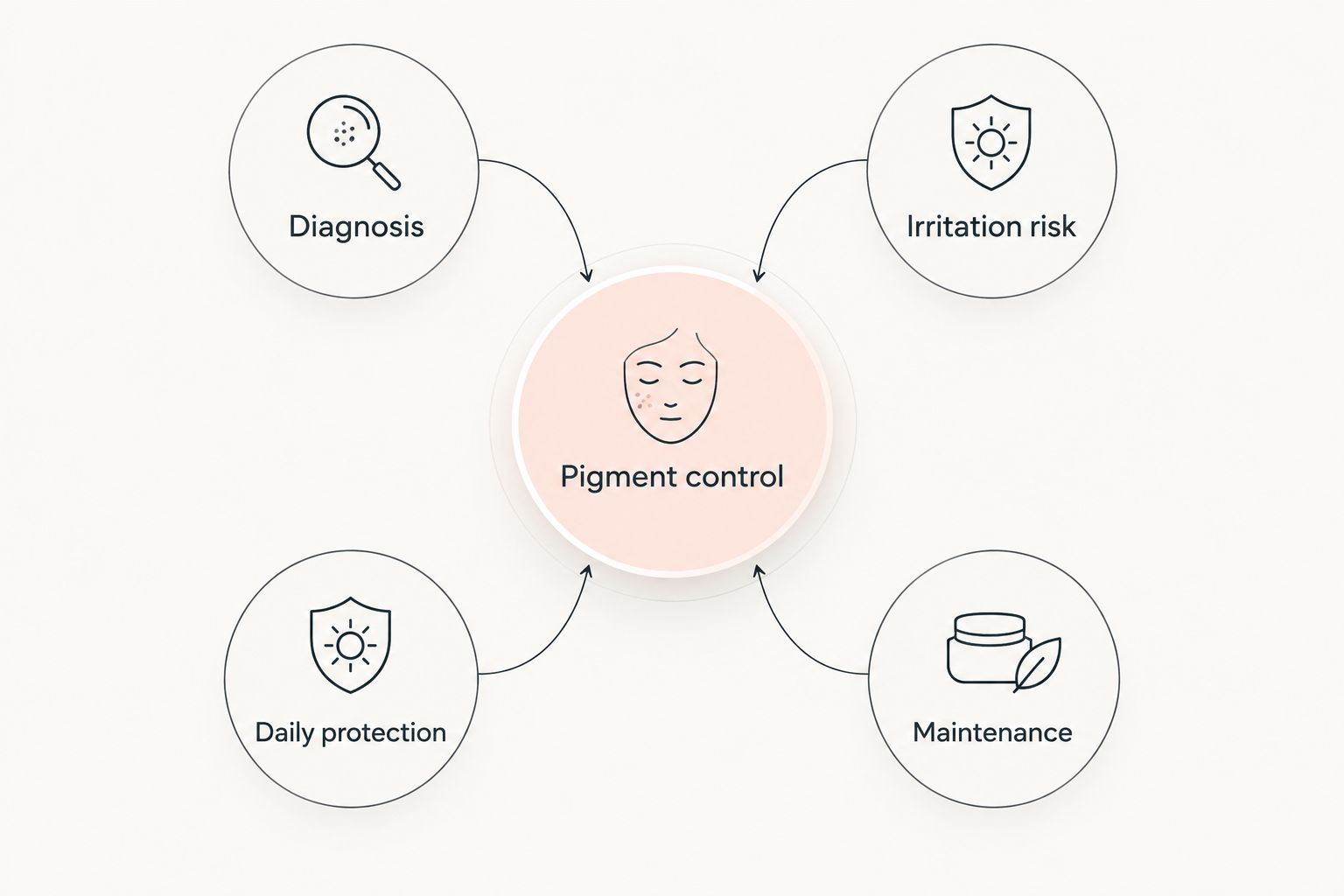
Use these criteria to compare your options in 2026. The strongest treatment plan addresses pigmentation without creating a cycle of irritation and further discoloration.
- Diagnosis: Establish whether the patches are melasma, another pigment condition, or a combination.
- Pigment control: Choose an intervention that addresses excess pigmentation, not just temporary smoothness.
- Irritation risk: Account for sensitive skin, existing inflammation, and previous reactions to treatment.
- Daily protection: Include ultraviolet and visible-light protection alongside any active treatment.
- Maintenance: Choose a plan you can continue safely, with appropriate medical review when needed.
A more intensive procedure is not automatically a better treatment. For melasma, an intervention that produces inflammation can undermine the result you wanted.
Best melasma treatments at a glance
This ranking separates the main treatment from prevention, alternatives, and specialist escalation. Sunscreen ranks highly because it supports every other option, not because it removes established patches by itself.
| Treatment | Best for | Standout role | Key limitation |
|---|---|---|---|
| Dermatologist-directed prescription topicals | Initial medical treatment | Targets pigmentation through a supervised regimen | Irritation and medication restrictions require review |
| Tinted broad-spectrum sunscreen | Daily prevention and maintenance | Combines ultraviolet protection with visible-light protection when formulated with iron oxides | Does not clear established melasma alone |
| Azelaic acid | An alternative topical approach | Addresses pigmentation without hydroquinone | Can sting or irritate; response varies |
| Superficial chemical peels | Selected procedural support | Adds controlled exfoliation to a broader plan | Inflammation can worsen discoloration |
| Selected laser or light procedures | Persistent melasma after standard care | Offers specialist-directed procedural treatment | Recurrence and pigment complications remain concerns |
| Oral tranexamic acid | Selected resistant cases | Provides a systemic, off-label treatment option | Requires medical screening, including clotting-risk assessment |
1. Prescription topicals: best for initial medical treatment
Dermatologist-directed topical treatment is the strongest starting point when you want to treat established melasma. Depending on your medical history, a dermatologist can prescribe hydroquinone or a combination containing hydroquinone, tretinoin, and a corticosteroid. These are medicines, not interchangeable additions to a facial routine.
Prescription treatment needs an endpoint and a maintenance plan. Do not keep extending a regimen simply because some pigment remains, and do not add exfoliating products without checking whether they fit the prescription.
Prescription topical pros:
- Directly addresses excess pigmentation.
- Allows treatment selection based on diagnosis and skin tolerance.
- Can be adjusted when irritation or incomplete improvement occurs.
Prescription topical cons:
- Irritation can complicate pigment management.
- Some ingredients require restrictions on duration or use.
- Pregnancy and breastfeeding affect medication selection; topical retinoids are avoided during pregnancy.
Best for: People with confirmed melasma who need a structured medical starting point rather than another cosmetic treatment.
For your 2026 plan, ask which medication treats the pigment, how to recognize irritation, and what replaces the initial regimen during maintenance. A prescription without those instructions leaves important decisions unresolved.
Verdict: Hold self-prescribing; choose dermatologist-directed treatment.
2. Tinted sunscreen: best for prevention and maintenance
Tinted broad-spectrum sunscreen is the daily foundation of melasma care. The American Academy of Dermatology recommends broad-spectrum, water-resistant sunscreen with SPF 30 or higher; its melasma guidance also recommends tinted sunscreen containing iron oxide to help protect against visible light.
Check the formulation, not just the tint. A cosmetic product with color is not automatically an adequate sunscreen, and an untinted sunscreen does not necessarily provide the same visible-light protection.
Tinted sunscreen pros:
- Supports topical and procedural treatment.
- Addresses an exposure that can worsen melasma.
- Fits into long-term maintenance rather than a short treatment course.
Tinted sunscreen cons:
- Does not remove existing melasma by itself.
- Requires adequate application and reapplication.
- An unsuitable shade or texture can make consistent use difficult.
Best for: Everyone managing melasma, including people who are not ready for prescription treatment or procedures.
Apply sunscreen 15 minutes before going outdoors. Reapply at least every 2 hours outdoors and after swimming or sweating, following the product directions. These are general sunscreen recommendations, not a guarantee against pigment changes.
Verdict: Buy a suitable tinted sunscreen and make protection non-negotiable.
3. Azelaic acid: best for an alternative topical approach
Azelaic acid is a topical option used to treat pigmentation, including melasma. It provides an alternative when a clinician decides that a hydroquinone-based approach is unsuitable. It is also used for acne, which matters when breakouts and pigment concerns overlap.
Do not interpret an alternative ingredient as an irritation-free ingredient. Azelaic acid can cause burning, stinging, dryness, or redness, especially when introduced alongside other active products.
Azelaic acid pros:
- Offers a pigment-treatment option without hydroquinone.
- Can address acne alongside pigmentation when clinically appropriate.
- Allows a topical approach without a procedure.
Azelaic acid cons:
- Can irritate already reactive skin.
- Is not a guaranteed replacement for prescription combination therapy.
- Requires consistent use and assessment rather than immediate judgment.
Best for: People seeking a different topical route after discussing skin tolerance and treatment suitability with a clinician.
Keep the rest of your routine simple while introducing treatment. Adding an acid cleanser, scrub, and peel at the same time makes it harder to identify the source of irritation.
Verdict: Hold until azelaic acid fits your overall treatment plan.
4. Superficial chemical peels: best for selected procedural support
Superficial chemical peels use controlled exfoliation and can support melasma treatment in selected patients. They belong alongside protection and an appropriate topical regimen, not in place of them. Deeper treatment is not automatically more effective for this condition.
Bonnie Frances Skin offers chemical peels. Before choosing one for melasma, discuss your diagnosis, current products, prior pigment reactions, and the proposed aftercare. A peel recommendation needs to explain why the procedure suits your skin.
Superficial chemical peel pros:
- Adds a procedural option to a broader pigment plan.
- Provides controlled exfoliation rather than unsupervised home experimentation.
- Can be selected according to skin tolerance and treatment goals.
Superficial chemical peel cons:
- Irritation can trigger post-inflammatory hyperpigmentation.
- Peeling and sensitivity require aftercare.
- Results do not eliminate the need for maintenance.
Best for: People with confirmed melasma whose clinician considers a superficial peel an appropriate adjunct.
For a 2026 appointment, ask what you should pause beforehand and how to manage your skin afterward. Do not improvise by applying stronger exfoliants when peeling starts.
Verdict: Hold until the peel, preparation, and aftercare are clearly defined.
5. Laser or light procedures: best for specialist escalation
Selected laser and light procedures can be considered for persistent melasma, but they are not the default first treatment. Device type, settings, skin tone, and the clinician's experience all matter. Treating melasma like an isolated sunspot overlooks its tendency to recur.
A specialist should explain both the intended benefit and the possibility of worsening pigment. That discussion matters particularly when you have previously developed dark marks after inflammation or procedures.
Laser or light procedure pros:
- Offers another treatment route after standard approaches prove insufficient.
- Allows specialist selection of a device and treatment strategy.
- Can form part of a combined treatment plan.
Laser or light procedure cons:
- Can cause pigment changes, including darkening or lightening.
- Melasma can recur after improvement.
- Requires careful patient selection and ongoing protection.
Best for: People with persistent melasma who have already reviewed topical treatment and protection with a dermatologist.
Ask why a particular device is appropriate for melasma, not merely whether it treats pigmentation. Also ask what happens if the patches become darker after treatment. A clear complication plan belongs in the decision.
Verdict: Wait for specialist assessment; skip a device-first sales pitch.
6. Oral tranexamic acid: best for selected resistant cases
Oral tranexamic acid is used off-label for melasma in selected patients. It is a medical treatment requiring a prescriber, not a supplement or a routine clinic add-on. Its suitability depends on your health history and other medicines.
The safety discussion includes blood-clot risk. A prescriber needs to review relevant history and contraindications before deciding whether treatment is appropriate; internet recommendations cannot replace that screening.
Oral tranexamic acid pros:
- Provides an additional option for selected difficult-to-treat cases.
- Can be considered when topical approaches have not provided adequate control.
- Allows treatment within a medically supervised plan.
Oral tranexamic acid cons:
- Requires screening for clotting-related risks and other contraindications.
- Is an off-label melasma treatment.
- Does not replace sunscreen or guarantee lasting clearance.
Best for: Carefully screened patients with resistant melasma under a qualified medical prescriber.
Ask why systemic treatment is justified, how safety will be monitored, and what maintenance follows. Do not obtain tablets from an unverified seller or copy another person's regimen.
Verdict: Hold unless a medical prescriber recommends and supervises treatment.
How these treatments are ranked
The ranking prioritizes pigment control, safety, and maintenance. Prescription topicals lead as an initial medical approach; sunscreen supports every stage. Azelaic acid provides an alternative, while peels, devices, and oral medication require increasingly specific selection.
This is a treatment-role comparison, not a claim that every person will respond in this order. American Academy of Dermatology public guidance informs the protection recommendations; medication and procedure selection requires individual clinical assessment.
Which melasma treatment should you choose?
Choose diagnosis, daily tinted sunscreen, and dermatologist-directed topical treatment before escalating to a procedure. That is the default decision for an undecided reader in 2026.
If you want supportive clinic care, Bonnie Frances Skin offers chemical peels and facials in Phoenix. Discuss whether those services fit your existing melasma plan. Hydrafacials and dermaplaning can address other skincare goals, but they do not replace targeted pigment treatment.
Bring your current product list and any history of treatment reactions to the appointment. If you are pregnant, breastfeeding, or planning pregnancy, raise that before selecting medication or a peel.
Review Phoenix skincare services
Explore the clinic before discussing whether a chemical peel fits your melasma care plan.
FAQ
What's the best treatment for melasma in Phoenix?
Dermatologist-directed topical treatment paired with daily tinted broad-spectrum sunscreen is the strongest starting approach. Confirm that the patches are melasma before choosing a peel, laser, or other procedure.
Can a chemical peel make melasma worse?
Yes, irritation from a chemical peel can worsen pigmentation. A carefully selected superficial peel can support treatment, but skin assessment and aftercare are essential.
Is a Hydrafacial a treatment for melasma?
A Hydrafacial is not a replacement for targeted medical melasma treatment. It can serve other skincare goals, while melasma needs a separate pigment-control and protection plan.
Is laser treatment better than prescription cream for melasma?
Laser treatment is not automatically better than prescription topical treatment for melasma. Devices require specialist selection because recurrence and treatment-related pigment changes remain concerns.
What sunscreen should I use for melasma?
Choose a tinted, broad-spectrum, water-resistant sunscreen with SPF 30 or higher and iron oxides for visible-light protection. Follow application directions and reapply at least every 2 hours outdoors and after swimming or sweating.
Can melasma come back after treatment?
Yes, melasma can recur after improvement. Daily protection and a clinician-directed maintenance plan remain important after the initial treatment ends.
Does Bonnie Frances Skin offer services relevant to melasma care?
Bonnie Frances Skin offers chemical peels and facials in Phoenix. Whether a service belongs in your melasma plan depends on the diagnosis, skin tolerance, and treatment selected; medical prescribing requires an appropriate clinician.
One last thing
Bring photographs of earlier flare-ups, not just a photograph of your skin today. A history of darkening after a peel, breakout, or irritating product gives the clinician useful context when selecting treatment.
For your 2026 plan, ask one final question: what continues after the pigment improves? Melasma care does not end when the patches look lighter.