Best overall for an evidence-led brightening routine: an L-ascorbic acid serum. Best for a first-time user seeking an alternative to acidic formulas: an ascorbyl glucoside serum; best for an oil-based routine: a tetrahexyldecyl ascorbate serum. These 2026 picks rank vitamin C formulation types, so you can evaluate the ingredient list rather than buy on a brightening claim alone.
- The best vitamin C serums for brightening start with a formula your skin tolerates consistently.
- L-ascorbic acid is the evidence-led default; acidic formulas can irritate sensitive skin.
- Ascorbyl glucoside and tetrahexyldecyl ascorbate are alternatives, not proven equivalents to every L-ascorbic acid serum.
- Bonnie Frances Skin offers Phoenix clients professional skincare lines and facial treatments alongside their home skincare routine.
Why this matters
Vitamin C can support a brighter, more even-looking complexion, but the ingredient name does not tell you how the finished serum performs. Concentration, stability, packaging, and the rest of the formula all matter. A serum that repeatedly irritates your skin is a poor choice, regardless of its active ingredient.
Bonnie Frances Skin is the local option for Phoenix readers pairing vitamin C serum research with professional skincare and facial treatments. Bonnie Frances Skin offers professional skincare lines, facials, and other skin treatments; a home serum and an in-clinic treatment serve different roles.
Start by identifying what you mean by brightening. General dullness, lingering acne marks, and persistent patches of pigmentation do not require identical decisions. Vitamin C belongs in that decision, but it should not replace identifying the underlying concern.
What makes the best vitamin C serums for brightening?
Use these criteria to choose a vitamin C serum in 2026:
- Identifiable vitamin C form: Look for L-ascorbic acid or a named derivative, not just a front-label vitamin C claim.
- Finished-formula tolerance: Consider fragrance, other active ingredients, and the texture—not vitamin C in isolation.
- Stability and packaging: Follow storage instructions and favor packaging that limits unnecessary exposure to air and light.
- Evidence that matches the claim: Research on an ingredient does not establish the performance of every serum containing it.
- Routine compatibility: Choose a texture you can comfortably layer with moisturizer and sunscreen.
- A clear treatment goal: Separate improving overall radiance from treating a diagnosed pigmentation disorder.
Concentration is relevant, but higher is not automatically better. L-ascorbic acid formulas commonly discussed in dermatology literature use concentrations around 10%–20%. That range is context for reading labels, not a requirement for every skin type or a reason to dismiss a lower-strength formula.
Vitamin C serums at a glance
| Ranked option | Best for | Standout feature | Key limitation |
|---|---|---|---|
| L-ascorbic acid serum | An evidence-led brightening routine | Direct vitamin C, with an established topical research base | Acidic formulas can irritate; stability requires attention |
| Ascorbyl glucoside serum | First-time users seeking an alternative to acidic formulas | A water-soluble vitamin C derivative | Requires conversion; results cannot be assumed equivalent to L-ascorbic acid |
| Tetrahexyldecyl ascorbate serum | People who prefer an oil-based routine | An oil-soluble vitamin C derivative | Independent clinical evidence is less established than for L-ascorbic acid |
These are formulation categories, not interchangeable products. Two serums with the same vitamin C ingredient can differ in concentration, packaging, fragrance, and supporting ingredients. Read the whole formula before treating either as the better option.
1. L-ascorbic acid: best vitamin C serum for evidence-led brightening
L-ascorbic acid is the active form of vitamin C and the most established starting point in topical vitamin C research. It supports antioxidant activity and can help improve the appearance of uneven pigmentation. For a reader who wants the clearest ingredient-level rationale, this is the default.
The trade-off is formulation difficulty. L-ascorbic acid is unstable under some conditions, and many water-based formulas use an acidic environment to support skin delivery. That acidity can be uncomfortable on reactive or already irritated skin.
L-ascorbic acid pros:
- Has an established research base for topical skincare use.
- Does not require conversion from a vitamin C derivative.
- Provides a clear ingredient to identify on the label.
- Fits a routine focused on antioxidant support and uneven-looking tone.
L-ascorbic acid cons:
- Acidic formulas can cause stinging or irritation.
- Exposure to air, light, and heat can affect stability.
- Ingredient research does not guarantee that a particular finished serum performs well.
Best for: Someone who prioritizes the established evidence and tolerates the finished formula without persistent discomfort.
Before choosing, examine the packaging and storage directions. Do not assume that a serum remains effective indefinitely because it still dispenses normally. Follow the manufacturer's guidance about changes in color, smell, or texture rather than applying a universal color rule to every formula.
Verdict: Buy an L-ascorbic acid serum when evidence is your priority and your skin tolerates the formula. Skip the idea that the highest concentration must be the best choice.
2. Ascorbyl glucoside: best vitamin C serum for a first-time alternative
Ascorbyl glucoside is a water-soluble vitamin C derivative. It offers a different formulation route from direct L-ascorbic acid and is used in products that do not depend on the same strongly acidic formulation approach. That makes it an option to evaluate when an acidic serum has been uncomfortable.
The distinction is not a guarantee of gentleness. Fragrance, exfoliating acids, and other ingredients can still make an ascorbyl glucoside serum irritating. Choose the finished product, not the reassuring sound of the derivative's name.
Ascorbyl glucoside pros:
- Offers an alternative to direct L-ascorbic acid.
- Works within water-based skincare formulations.
- Gives first-time users another ingredient category to consider.
Ascorbyl glucoside cons:
- Requires conversion to active vitamin C for its direct vitamin C effects.
- Does not establish equal results to a particular L-ascorbic acid serum.
- Does not make a formula fragrance-free or suitable for every sensitive skin type.
Best for: A first-time vitamin C user seeking an alternative to acidic formulas, while still checking the complete ingredient list.
In 2026, choose an ascorbyl glucoside serum by asking a specific question: does this formulation make regular use easier without adding irritation? That is more useful than asking whether all derivatives are better or worse than direct vitamin C.
If your skin is actively inflamed, simplify the routine before introducing another active ingredient. Persistent burning is not evidence that a serum is working.
Verdict: Buy an ascorbyl glucoside serum when an alternative formulation suits your routine; skip claims that it automatically matches L-ascorbic acid.
3. Tetrahexyldecyl ascorbate: best vitamin C serum for an oil-based routine
Tetrahexyldecyl ascorbate is an oil-soluble vitamin C derivative. It belongs on your shortlist when you prefer a lipid-rich serum or already enjoy oil-based skincare textures. Its main decision advantage is formulation fit, not proven superiority for brightening.
An oil-soluble ingredient does not mean the entire product is an oil, nor does it guarantee that the formula moisturizes enough on its own. Check the vehicle and supporting ingredients. Your sunscreen must still apply evenly over whatever you choose.
Tetrahexyldecyl ascorbate pros:
- Fits lipid-based formulation approaches.
- Offers an alternative to an acidic L-ascorbic acid serum.
- Gives texture-focused buyers another vitamin C option.
Tetrahexyldecyl ascorbate cons:
- Has less established independent clinical evidence than L-ascorbic acid.
- Oil solubility alone does not prove better skin delivery or brighter results.
- A rich texture can be a poor match for your layering preferences.
Best for: Someone who prefers an oil-based routine and accepts the limits of ingredient-level evidence.
Evaluate this category with your moisturizer and sunscreen, not in isolation. If the finished routine pills, feels uncomfortable, or makes sunscreen harder to apply evenly, the serum is not fitting its job.
Verdict: Buy a tetrahexyldecyl ascorbate serum for a preferred formulation texture; skip it if your only reason is an unsupported better-absorption claim.
Direct vitamin C versus derivatives
L-ascorbic acid provides direct vitamin C. Ascorbyl glucoside and tetrahexyldecyl ascorbate are vitamin C derivatives; their role depends on formulation and conversion in the skin. That distinction explains why matching percentages across different ingredient names does not establish matching performance.
| Formulation distinction | L-ascorbic acid | Vitamin C derivatives |
|---|---|---|
| Ingredient role | Direct vitamin C | Requires conversion |
| Tolerance consideration | Acidic formulas | Formula-dependent tolerance |
| Buying decision | Prioritize evidence and stability | Prioritize formula fit without assuming equivalence |
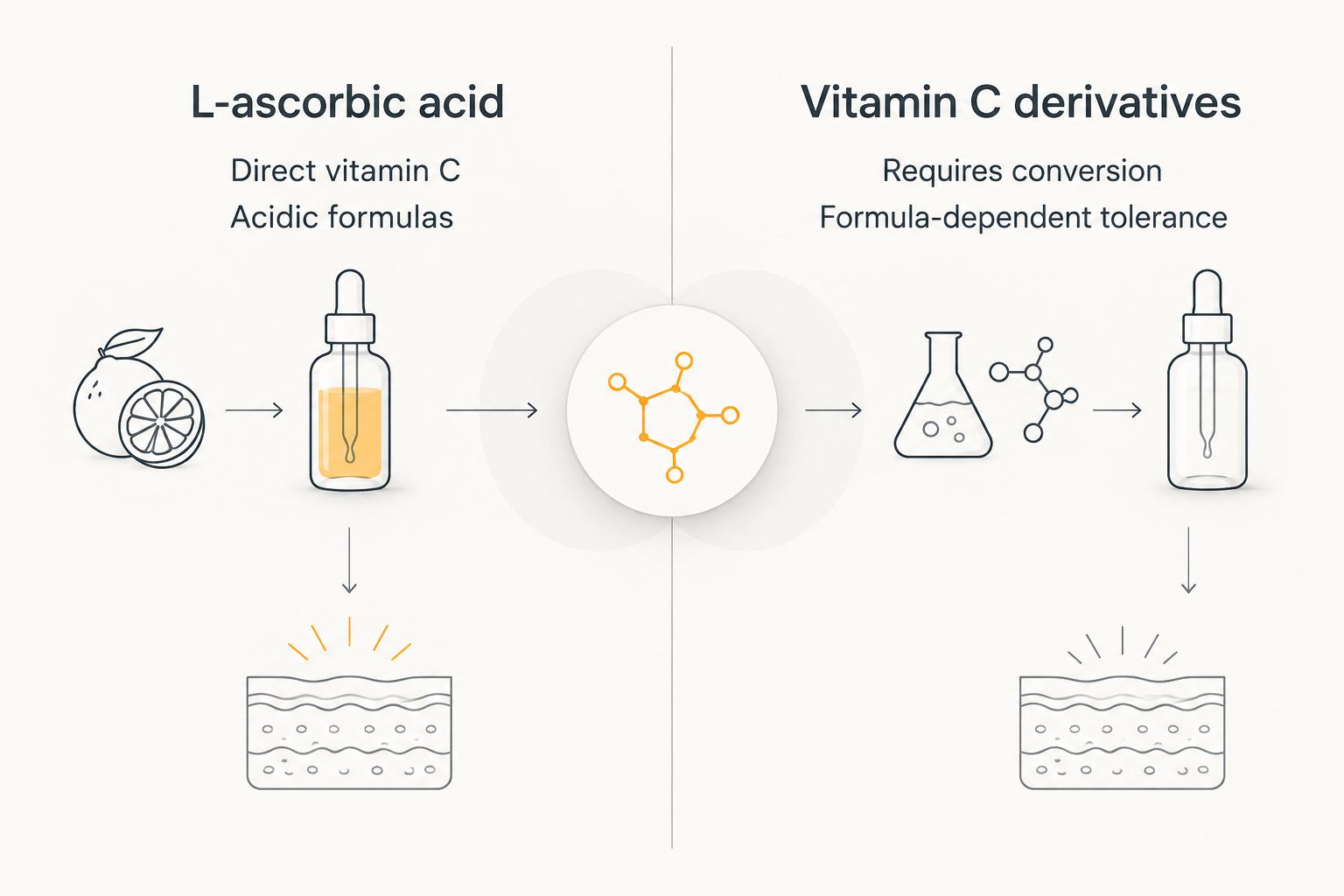
The best comparison is between finished formulas, not percentages printed beside different ingredients. A derivative's concentration cannot be treated as a direct conversion chart for L-ascorbic acid strength.
How to introduce a vitamin C serum
Your 2026 brightening routine should make tolerance and sun protection easy to maintain. Introduce the serum without simultaneously changing your exfoliant, retinoid, and moisturizer; otherwise, you make a reaction harder to trace.
- Check your baseline. Do not introduce a new active onto skin that is already persistently burning, peeling, or inflamed.
- Test the product. The American Academy of Dermatology recommends testing a new skincare product on a small area for 7–10 days before broader use.
- Follow the label. Application frequency, storage, and layering directions belong to the specific finished product.
- Protect your skin. Use broad-spectrum, water-resistant sunscreen with SPF 30 or higher. The American Academy of Dermatology recommends reapplying every 2 hours outdoors and after swimming or sweating.
- Watch tolerance. Stop using a serum that causes persistent irritation and seek professional advice if symptoms continue.
Vitamin C is not sunscreen. Antioxidant support does not replace UV protection, and a brighter-looking complexion is not evidence that your skin is protected from sunlight.
When a serum is not the whole answer
A vitamin C serum can support a brightening routine, but persistent pigmentation deserves a clearer plan than repeatedly switching bottles. Melasma, post-inflammatory hyperpigmentation, and isolated changing spots are not interchangeable concerns. A changing or suspicious spot needs medical assessment, not a stronger cosmetic serum.
For local treatment research, the guide to skin treatments for hyperpigmentation in Phoenix addresses a different decision from choosing a daily topical.
Bonnie Frances Skin offers chemical peels, facials, and SkinPen microneedling, among other services. That service list does not mean every treatment is appropriate for every pigmentation concern. Ask about suitability, preparation, and aftercare before combining a treatment with active skincare.
How we ranked
This 2026 ranking prioritizes established ingredient evidence, formulation differences, tolerance, and routine fit. L-ascorbic acid takes the default slot because its topical research base is more established; the derivatives earn separate slots for different formulation preferences.
The ranking does not claim head-to-head product testing or assign results to unnamed finished serums. Brand recognition, a higher concentration, and a brightening label are not substitutes for evidence about the formula you actually use.
Which vitamin C serum should you choose?
Choose L-ascorbic acid as the evidence-led default if your skin tolerates it. Choose ascorbyl glucoside when you want to evaluate an alternative to acidic formulas, or tetrahexyldecyl ascorbate when an oil-based texture fits your routine better.
For your 2026 purchase, make the final decision from the full ingredient list, packaging, and directions. Do not buy several vitamin C serums to layer together. One tolerable formula is a clearer starting point than a collection of overlapping actives.
FAQ
What's the best vitamin C serum for brightening?
An L-ascorbic acid serum is the evidence-led default for brightening when your skin tolerates the finished formula. Ascorbyl glucoside and tetrahexyldecyl ascorbate offer alternative formulation options, but they are not automatically equivalent.
Is a higher vitamin C percentage always better?
No, a higher vitamin C percentage does not automatically make a serum better. Concentration must be considered alongside the vitamin C form, stability, delivery, and your skin's tolerance.
Which vitamin C serum should I choose for sensitive skin?
Choose a finished formula that avoids your known triggers rather than relying on a vitamin C ingredient name alone. A derivative is an option to evaluate, but fragrance and other active ingredients can still cause irritation.
Can a vitamin C serum remove dark spots?
Vitamin C can help improve the appearance of uneven pigmentation, but it does not guarantee removal of dark spots. Persistent pigmentation needs a plan that accounts for its cause and includes sun protection.
Should I use vitamin C in the morning or at night?
Follow the finished product's directions; vitamin C can fit either a morning or evening routine. Morning use still requires sunscreen because vitamin C does not replace UV protection.
Can I use vitamin C with retinol or exfoliating acids?
Vitamin C can be part of a routine containing retinoids or exfoliating acids, but the combination can increase irritation. Introduce changes separately and follow professional advice when your skin is reactive or you are preparing for a treatment.
Does Bonnie Frances Skin offer professional skincare and facials?
Bonnie Frances Skin offers professional skincare lines and facials in Phoenix, Arizona. Its services also include hydrafacials, dermaplaning, SkinPen microneedling, and chemical peels.
One last thing
Photograph your skin under consistent lighting before changing your 2026 routine. Similar lighting, angle, and camera settings make comparisons more useful than judging your complexion in a different mirror each day. Keep the rest of your routine steady so you can evaluate the serum rather than several simultaneous changes.