Best overall for post-acne marks and mild surface unevenness: a well-tolerated retinoid. Best for preventing darker marks: broad-spectrum sunscreen. Best for discoloration alongside breakouts: azelaic acid. The best professional skincare products for acne scars in 2026 depend on whether you have flat marks, indented scars, or raised scars—not the label on the bottle.
- The best professional skincare products for acne scars depend on whether you have discoloration or structural scarring.
- Retinoids suit post-acne marks and mild unevenness; sunscreen helps prevent marks from darkening.
- Indented and raised acne scars need assessment rather than another brightening serum.
- Bonnie Frances Skin offers professional skincare and SkinPen microneedling in Phoenix; discuss your skin goals before choosing treatment.
Why this matters
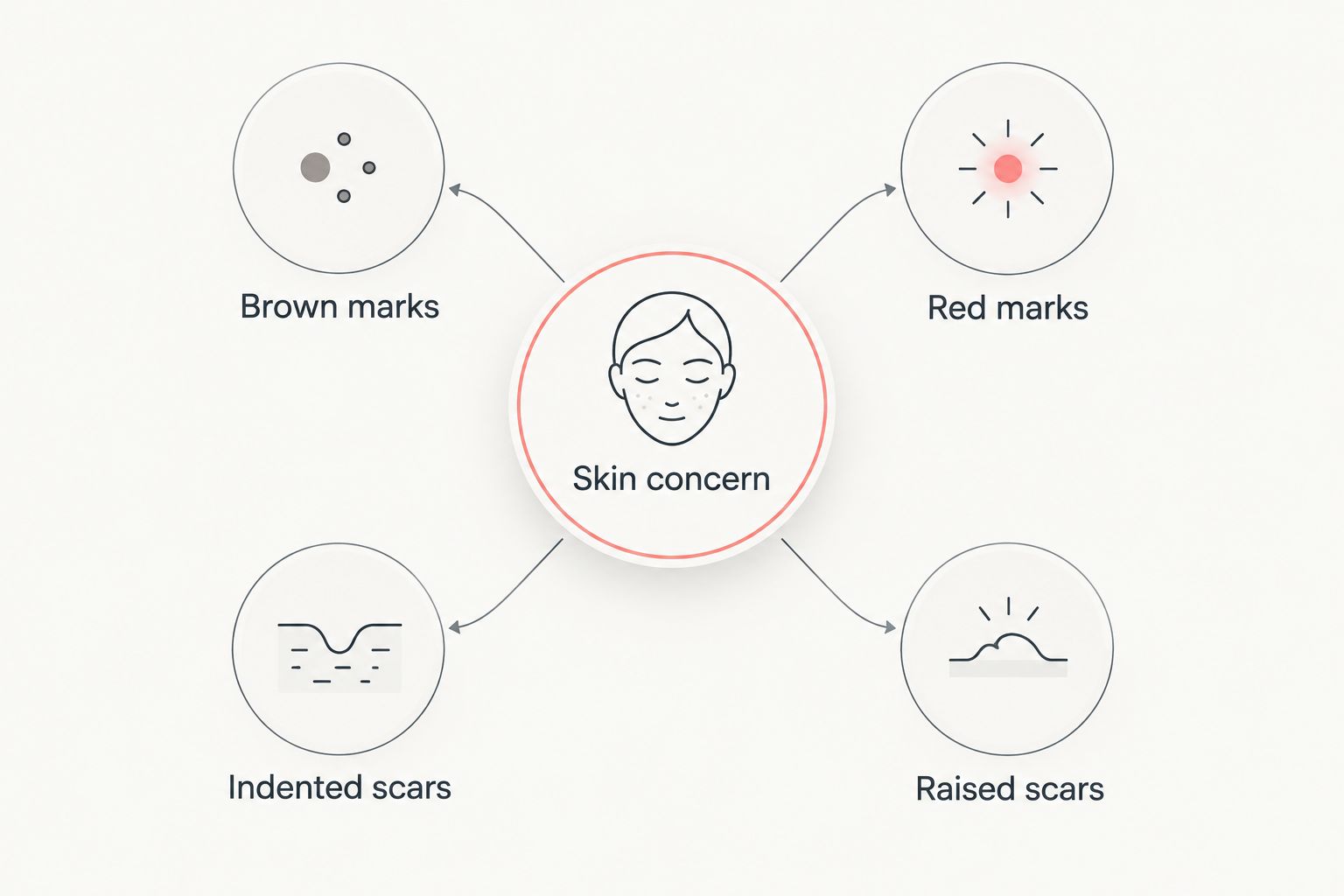
People use acne scars to describe different problems. Flat brown marks are usually post-inflammatory hyperpigmentation. Flat red or pink marks reflect a different process. Depressions and raised areas are changes in skin structure.
A product that fades discoloration does not necessarily improve a scar's depth. Treating those concerns as interchangeable leads to unnecessary exfoliation and unrealistic expectations.
Bonnie Frances Skin offers professional skincare lines including Skinbetter, Epicutis, Jan Marini, Epionce, and Alastin. Choose within those lines by the specific formula and your skin's needs, not by assuming every product treats acne scars.
What makes the best skincare for acne scars?
Use these criteria to choose professional skincare products in 2026:
- Correct target: Match the formula to brown marks, ongoing acne, dryness, or superficial unevenness.
- Relevant active: Look for an ingredient with an established role in that concern, rather than a vague renewal claim.
- Tolerability: A product that repeatedly causes burning or peeling is not a good fit for your routine.
- Routine compatibility: Consider your existing acne medication, exfoliants, and any planned procedures.
- Photoprotection: Include broad-spectrum sunscreen when treating discoloration.
- Realistic limits: Do not expect a topical product to release tethered scars or flatten raised scars reliably.
Professional is a distribution or positioning term, not proof of better results. The complete formulation, consistent use, and correct diagnosis matter more than where you buy the bottle.
Professional acne-scar skincare at a glance
These rankings compare ingredient and formula categories, not individual branded products. Each category has a separate job; you do not need every option.
| Rank and option | Best for | Standout role | Key limitation |
|---|---|---|---|
| Retinoid | Flat post-acne marks and mild surface unevenness | Supports skin turnover and acne management | Irritation risk; does not replace structural scar treatment |
| Broad-spectrum sunscreen | Preventing discoloration from darkening | Protects against ultraviolet exposure | Does not fill depressions or remove existing scars |
| Azelaic acid | Brown marks with ongoing breakouts | Addresses acne and uneven pigmentation | Can sting; does not correct scar depth |
| Vitamin C serum | Supplemental support for uneven tone | Antioxidant and brightening role | Performance depends on formulation and tolerance |
| Barrier-supporting moisturizer | Dryness or irritation during treatment | Helps maintain hydration and treatment tolerability | Does not directly remodel acne scars |
1. Retinoid: best for marks and mild surface unevenness
Retinoids support skin turnover, and some are established acne treatments. They can help with post-acne hyperpigmentation and superficial unevenness, but cosmetic retinol and prescription retinoids are not interchangeable.
The right choice depends on your skin, acne treatment, and tolerance. Start with a routine you can maintain rather than choosing the strongest formula by default.
Retinoid pros:
- Can address acne and residual marks within the same treatment plan.
- Supports gradual improvement in uneven pigmentation.
- Has a role in managing superficial skin texture.
Retinoid cons:
- Can cause dryness, peeling, and irritation.
- Does not reliably correct deep or tethered scars.
- Requires pregnancy-related precautions; avoid retinoids during pregnancy and discuss use when planning pregnancy.
Best for: Someone with flat post-acne marks, mild unevenness, and skin that tolerates a retinoid.
Check the actual ingredient rather than treating every renewal serum as equivalent. For a closer look at the category, read the guide to retinol products for skin renewal.
Verdict: Buy for appropriate post-acne concerns; skip the expectation that retinoids erase deep scars.
2. Broad-spectrum sunscreen: best for protecting fading marks
Sunscreen belongs in an acne-mark routine because ultraviolet exposure can darken hyperpigmentation. It protects the progress of a treatment plan; it is not a scar-removal product.
For your 2026 routine, follow American Academy of Dermatology public guidance: choose broad-spectrum, water-resistant sunscreen with SPF 30 or higher. Apply it about 15 minutes before going outdoors and reapply every 2 hours outdoors, as well as after swimming or sweating, according to the label.
Broad-spectrum sunscreen pros:
- Helps prevent ultraviolet-related darkening of post-acne marks.
- Fits alongside retinoids and other pigment-focused treatments.
- Protects skin beyond the specific area affected by acne.
Broad-spectrum sunscreen cons:
- Does not lift depressed scars or flatten raised scars.
- Texture, eye sting, or a visible cast can discourage consistent use.
Best for: Anyone treating post-acne discoloration, especially when outdoor exposure is part of daily life.
Choose a texture you will apply consistently. A theoretically appealing formula that stays in the drawer does not protect your skin.
Verdict: Buy as the foundation of a discoloration routine, not as a stand-alone scar treatment.
3. Azelaic acid: best for brown marks with ongoing breakouts
Azelaic acid has established uses in acne and hyperpigmentation management. It is a relevant option when new blemishes and older brown marks coexist.
Do not confuse brown pigmentation with persistent redness. Similar-looking marks can need different treatment, and azelaic acid does not repair indented scars.
Azelaic acid pros:
- Addresses acne and uneven pigmentation.
- Offers an alternative category when retinoids are unsuitable.
- Can fit a targeted routine without adding a separate exfoliating step.
Azelaic acid cons:
- Can cause stinging, itching, or dryness.
- Formulations and strengths are not interchangeable.
- Does not correct structural depressions.
Best for: Someone whose main concerns are brown post-acne marks and continuing breakouts.
Ask a qualified clinician how azelaic acid fits with your current medication. Adding it on top of an already irritating routine is not the same as building a useful treatment plan.
Verdict: Buy when acne and brown marks are the targets; hold if your skin is already inflamed or irritated.
4. Vitamin C serum: best for supplemental tone support
Vitamin C is an antioxidant used in skincare for uneven tone and signs of sun exposure. It can support a pigment-focused routine, but it is not a substitute for sunscreen or an acne treatment.
Formula matters here. The vitamin C form, stability, packaging, and your skin's tolerance all affect whether a serum is a sensible addition.
Vitamin C serum pros:
- Offers antioxidant support.
- Can complement a routine focused on uneven pigmentation.
- Provides a separate option when additional exfoliation is unnecessary.
Vitamin C serum cons:
- Some formulations sting sensitive or irritated skin.
- Does not release tethered scars or rebuild deep depressions.
- Adds complexity when a basic routine is not yet consistent.
Best for: Someone with a stable, well-tolerated routine who wants additional support for uneven tone.
Persistent flat red marks are not automatically a reason to add vitamin C. Identify the concern before buying another brightening product.
Verdict: Hold until sunscreen and your primary treatment are consistent; buy only for a clear additional purpose.
5. Barrier-supporting moisturizer: best for treatment-related dryness
A moisturizer helps maintain hydration and supports the skin barrier. That matters when acne treatments or retinoids leave your skin dry and uncomfortable.
Look for a formula suited to acne-prone skin and your sensitivity history. Ingredients such as glycerin and ceramides have established moisturizing and barrier-support roles, but the complete formula still matters.
Barrier-supporting moisturizer pros:
- Helps reduce dryness and tightness.
- Supports comfort during an active-treatment routine.
- Can make a simpler routine easier to maintain.
Barrier-supporting moisturizer cons:
- Does not directly fade every type of post-acne mark.
- Does not replace treatment for structural scars.
Best for: Someone whose treatment routine causes dryness, peeling, or tightness.
Persistent burning is a reason to reassess the irritating product, not simply cover it with a heavier moisturizer. Seek clinical advice when irritation continues.
Verdict: Buy for hydration and treatment support; skip scar-removal claims.
Match the routine to the mark
Before choosing professional skincare in 2026, examine what remains after a blemish heals. Look in even lighting rather than judging your skin only under harsh overhead shadows.
- Brown marks: Prioritize sunscreen and an appropriate pigment-focused treatment.
- Red marks: Seek advice about persistent redness rather than assuming it is brown pigmentation.
- Indented scars: Discuss procedural assessment instead of repeatedly switching serums.
- Raised scars: Seek dermatology evaluation rather than trying stronger home exfoliation.
Brown marks and indented scars can occur together. A useful plan addresses both without claiming that one serum will solve every visible change.
Bonnie Frances Skin offers SkinPen microneedling and chemical peels in Phoenix. Discuss suitability, risks, and aftercare before choosing either service; offering a treatment does not establish that it is right for every scar type.
Explore your skincare options
Review professional skincare and treatment services at the Phoenix clinic.
How these categories were ranked
The 2026 ranking prioritizes matching the concern, established ingredient roles, tolerability, and realistic limits. Retinoids lead for marks and mild unevenness; sunscreen leads for protection against further darkening.
This is not a claim that every formula within a category performs equally. No named professional skincare line wins automatically, and no topical category earns a recommendation for every scar type.
Which skincare should you choose?
For flat post-acne marks, start with sunscreen and one suitable treatment—not several new actives at once. Choose a retinoid when appropriate, consider azelaic acid for acne with brown marks, and add moisturizer according to your skin's needs.
Bonnie Frances Skin is best for Phoenix clients seeking professional skincare alongside discussion of the clinic's listed treatment services. Bring your current products and describe whether your priority is discoloration, active acne, or scar depth.
If your main concern is indentation or raised tissue, prioritize assessment. Buying another brightening serum does not resolve a mismatch between the product and the problem.
FAQ
What are the best professional skincare products for acne scars in 2026?
For flat post-acne marks, the most relevant categories are broad-spectrum sunscreen and an appropriate retinoid or pigment-focused treatment. Indented and raised scars need assessment because topical skincare has structural limits.
Can professional skincare completely remove acne scars?
Professional skincare does not reliably remove indented or raised acne scars. Products can help with associated discoloration, acne control, hydration, and superficial unevenness.
Is retinol better than vitamin C for acne scars?
A suitable retinoid is the stronger starting category for acne-related marks and mild unevenness; vitamin C is a supplemental option for uneven tone. Neither category reliably corrects deep scars, and tolerance affects the choice.
Does sunscreen fade acne scars?
Sunscreen helps prevent post-acne pigmentation from darkening, but it does not fill or flatten structural scars. Use broad-spectrum SPF 30 or higher alongside an appropriate treatment plan.
Should I use acids and retinol together for acne marks?
Do not automatically combine exfoliating acids and retinol for acne marks. The combination can increase irritation, so have a qualified clinician review your routine before adding overlapping actives.
Are professional skincare brands always better for acne scars?
No, professional distribution does not establish that a product is better for acne scars. The specific formula, correct treatment target, and your ability to tolerate it determine whether it belongs in your routine.
When should I consider microneedling instead of another serum?
Consider a professional assessment when your main concern is depressed acne scars rather than flat discoloration. Microneedling suitability depends on scar type, active skin conditions, medical history, and treatment risks.
One last thing
Controlling new acne is part of treating old acne scars. If new breakouts keep appearing, a routine devoted only to fading yesterday's marks leaves the source of new marks unaddressed.
Make your next decision about the concern you actually have—not the strongest ingredient or the most expensive-looking bottle.