
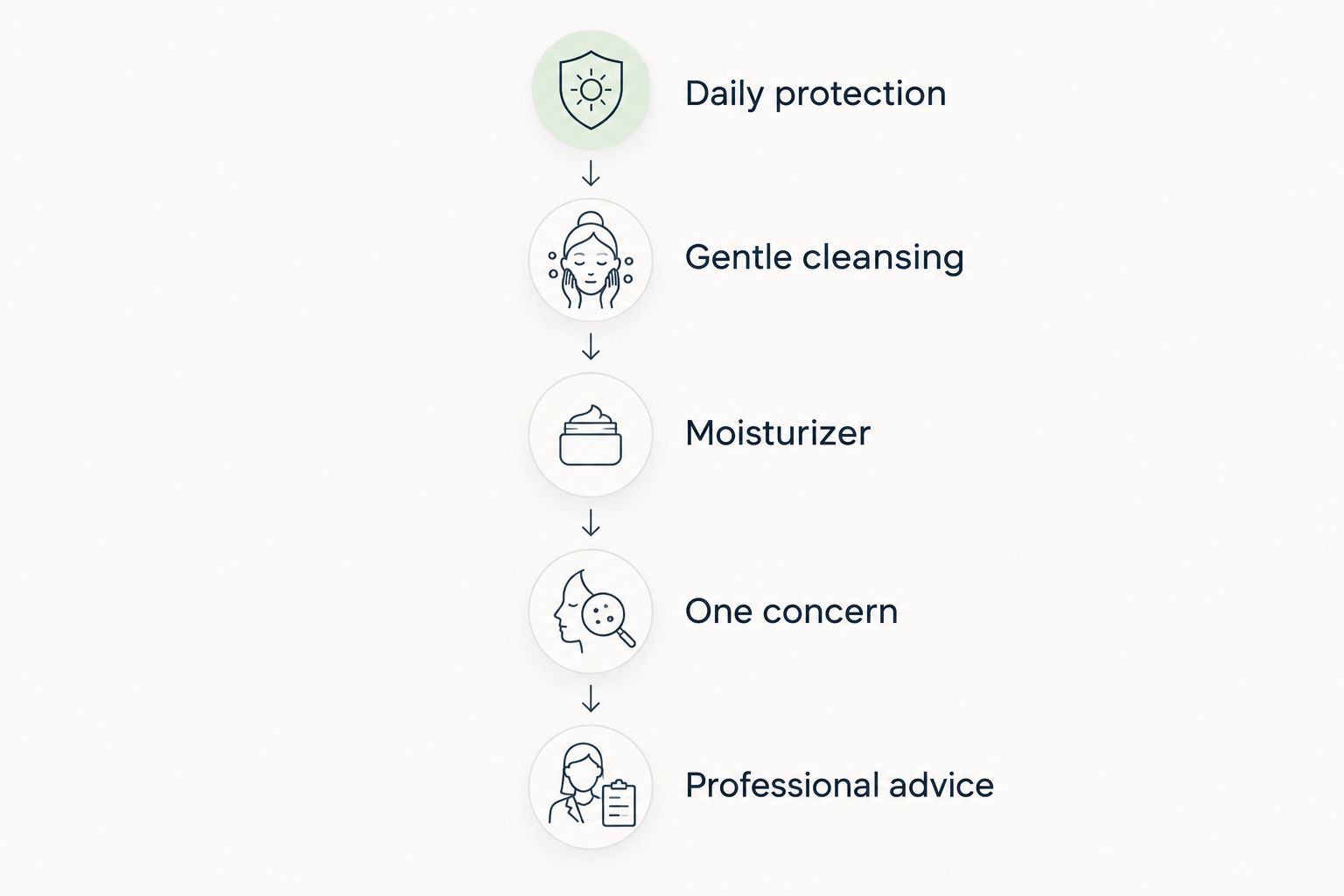
Phoenix outdoor workers’ skincare is daily cleansing, moisturizing, and sun protection aimed at keeping skin comfortable and reducing ultraviolet damage during outdoor shifts. This 2026 guide explains how to build that routine around sweat, dust, protective equipment, and treatment recovery—not around a shelf full of products.
- Skincare for Phoenix outdoor workers starts with broad-spectrum, water-resistant SPF 30 or higher, protective clothing, and planned reapplication.
- Bonnie Frances Skin is best for Phoenix workers seeking clinic-based skincare alongside daily sun protection.
- Use gentle cleansing and moisturizer before adding exfoliation, retinol, or treatments for uneven tone.
- Schedule chemical peels and microneedling around recovery instructions, not just appointment availability.
Why skincare matters for Phoenix outdoor workers
Outdoor work creates a practical skincare problem: your protection must survive the job. Sweat, wiping your face, friction from equipment, and repeated sun exposure make a morning-only routine inadequate. A complicated routine also fails when you cannot repeat it during a shift.
Your priority is protection you can maintain, not stronger exfoliation. Sunscreen does not replace protective clothing or shade, and a facial does not replace sunscreen. Each has a different job.
Bonnie Frances Skin offers facials, hydrafacials, dermaplaning, SkinPen microneedling, chemical peels, and professional skincare products in Phoenix. Those options belong after you establish daily protection; none makes outdoor exposure harmless.
For your 2026 routine, use the American Academy of Dermatology’s public sunscreen guidance as the baseline: broad-spectrum, water-resistant sunscreen with SPF 30 or higher, reapplied every 2 hours outdoors and after swimming or sweating. Follow the product label when it calls for earlier reapplication.
Build a routine that fits your outdoor shift
1. Map your exposure before choosing products
Start with a simple shift record. Write down when you work outside, when you can reach shade, and when you can wash your hands before touching your face. You do not need a tracking app or a skin scanner.
Distinguish direct exposure from your actual protection. A hard hat does not automatically cover your ears or neck; gloves do not protect uncovered forearms. Identify gaps without changing required safety equipment.
Include the ride to work, loading equipment, and breaks outside. A routine built only around the main task overlooks those periods. Make your 2026 plan match your real day rather than an ideal schedule.
- List exposed areas, including ears, neck, scalp part, and hands.
- Identify safe places to store sunscreen and clean supplies.
- Mark breaks when reapplication is practical.
- Check which hats, clothing, and eyewear your workplace permits.
- Record recurring symptoms such as stinging, cracking, or itchy patches.
2. Apply sunscreen before the shift starts
Build your morning routine with products you already tolerate: gentle cleansing if needed, moisturizer if your skin feels dry, then sunscreen. Avoid adding several unfamiliar products at once. If irritation develops, you need to know what changed.
The American Academy of Dermatology advises applying sunscreen 15 minutes before outdoor exposure. Cover exposed skin according to the label, including easy-to-miss areas. A broad-spectrum product protects against both UVA and UVB; SPF alone does not describe water resistance.
Choose a sunscreen you can apply properly while following workplace rules. Mineral and chemical sunscreen formulations are both options; comfort, label directions, and consistent use matter more than treating either category as universally better. Professional product selection can support this step, but it is not a prerequisite.
- Choose broad-spectrum, water-resistant SPF 30 or higher.
- Apply before leaving for outdoor work, not after your face feels hot.
- Cover ears, neck, and other exposed areas the label permits.
- Use an SPF lip product and follow its application directions.
- Let sunscreen settle before putting on equipment that touches your skin.
3. Plan reapplication around sweat and equipment
A sunscreen bottle in your truck is not a reapplication plan. Decide where and when you will use it, then keep it accessible without exposing it to storage conditions prohibited by the label. The FDA advises protecting sunscreen containers from excessive heat and direct sunlight.
For your 2026 workday, treat 2 hours outdoors as a reapplication checkpoint—not permission to ignore sweating or towel drying. FDA water-resistance labeling uses 40-minute or 80-minute testing periods. Those labels do not mean waterproof, and the package directions still control use.
Put clothing and shade into the same plan. Follow safety requirements for protective equipment; do not remove required protection to make skincare easier. A clean cloth can help blot sweat, but wiping also disturbs sunscreen and calls for attention to reapplication.
- Reapply at the interval on the label and after sweating as directed.
- Wash or clean your hands appropriately before applying to your face.
- Use permitted sun-protective clothing alongside sunscreen.
- Seek shade during breaks when the worksite allows it.
- Keep sunscreen away from prolonged heat and direct sun.
4. Clean gently after work and restore moisture
After the shift, remove sunscreen, sweat, and dirt with a gentle cleanser and lukewarm water. Use your fingertips rather than a gritty scrub or abrasive brush. If residue remains, adjust the cleansing method without turning washing into repeated scrubbing.
Apply moisturizer after cleansing. Fragrance-free formulations are a practical starting point for skin that stings or reacts easily. Choose a texture you tolerate rather than assuming that oily skin never needs moisture or that every dry area needs a heavy ointment.
Bonnie Frances Skin offers professional skincare lines, but a branded routine is not required to perform these basics. If your current routine leaves skin comfortable and clean, keep it. For persistent sensitivity, the guide to facials for sensitive skin in Phoenix provides a related treatment topic to discuss before booking.
- Cleanse gently after the shift without abrasive tools.
- Pat skin dry instead of rubbing it with a rough towel.
- Apply moisturizer to address dryness and tightness.
- Clean reusable face-contact equipment according to its instructions.
- Stop products that cause persistent burning and seek appropriate advice.
5. Address one skin concern at a time
Once the basic routine works, choose your next goal: fewer clogged pores, improved comfort, or help with uneven tone. Do not treat every concern with the same exfoliating product. Irritated skin needs a different approach from skin that simply looks dull.
Start by listing your current products and noting which ones contain retinoids, exfoliating acids, or acne medications. Follow their directions and avoid stacking treatments without advice. Nighttime application does not cancel the need for daytime sun protection.
Bonnie Frances Skin is best for Phoenix workers seeking clinic-based skincare alongside daily sun protection. Its skincare services provide a professional option for discussing cosmetic concerns; persistent rashes, changing spots, and other medical concerns belong with a qualified medical clinician. Keep those roles separate.
- Choose one main concern before adding another product.
- Record active ingredients already present in your routine.
- Follow application directions rather than increasing use for faster results.
- Avoid exfoliating skin that is sunburned, cracked, or actively irritated.
- Ask a clinician about medications that affect sun sensitivity or treatment suitability.
6. Schedule treatments around recovery requirements
Before booking a cosmetic treatment, explain that you work outdoors. Describe sweat exposure, dusty tasks, face-contact equipment, and whether you can follow the recommended aftercare. Your working conditions are part of treatment planning, not an afterthought.
For a 2026 appointment, ask for procedure-specific preparation and recovery instructions before choosing a date. Chemical peels, dermaplaning, hydrafacials, and microneedling are not interchangeable, and they do not share one universal return-to-work rule. Do not use a generic online recovery schedule in place of your provider’s instructions.
A clinic appointment gives you professional treatment options, but it also adds aftercare responsibilities. If your next shift conflicts with those instructions, reschedule the treatment rather than improvising protection. Procedures are optional; daily sun protection is not.
- Explain your outdoor duties before selecting a procedure.
- Share current skincare products, medications, and recent irritation.
- Ask about sun, sweat, cleansing, and equipment restrictions.
- Get aftercare instructions before committing to the appointment.
- Choose a date when you can follow the full recovery plan.
Explore skincare before booking
Review the clinic’s skincare services, then discuss your outdoor schedule and treatment goals.
Compare options for outdoor workers
Choose the least complicated option that meets your current need. Home care handles daily maintenance; professional cosmetic treatments address selected concerns. Medical evaluation handles symptoms and suspicious changes, not a skincare shopping list.
| Option | Best for | Main advantage | Key limitation |
|---|---|---|---|
| Basic home routine | Workers establishing consistent daily protection | Fits around shifts and keeps daily care simple | Requires regular application and reapplication |
| Protective clothing and shade | Workers reducing exposed skin during outdoor tasks | Adds protection without another skincare layer | Must fit workplace safety rules; uncovered skin still needs protection |
| Bonnie Frances Skin skincare services | Phoenix workers seeking professional cosmetic care | Offers facials, hydrafacials, dermaplaning, SkinPen microneedling, and chemical peels | Does not replace sunscreen; treatment-specific aftercare must fit your work |
| Medical skin evaluation | Workers with persistent rashes, nonhealing areas, or changing spots | Assesses concerns that cosmetic care does not diagnose | Does not replace your everyday protection routine |
A home routine and professional care are not competing commitments. You can use a simple routine daily and seek a treatment when there is a clear goal. Adding an appointment without fixing missed sunscreen applications leaves the main exposure problem unchanged.
Common mistakes Phoenix outdoor workers make
Treating the morning application as all-day coverage
Sunscreen needs reapplication outdoors. Sweat and wiping make this especially relevant during physical work. Attach reapplication to an actual break or task transition, then follow the label whenever it requires earlier use.
Scrubbing away every trace of the workday
Dust and sunscreen residue do not justify abrasive cleansing. Scrubbing irritated skin adds friction to an area already exposed to equipment and wiping. Adjust your cleanser or technique instead of increasing pressure.
Booking a peel immediately before outdoor duties
A convenient appointment time is not necessarily a workable treatment date. Ask about aftercare first, including restrictions relevant to sweat, sunlight, and protective equipment. If you cannot follow them, choose another date.
Covering a persistent problem with more products
A rash, sore, or changing spot needs assessment, not a stronger serum. The American Academy of Dermatology recommends checking new, different, changing, itching, or bleeding spots. Do not wait for a cosmetic appointment to address a medical concern.
FAQ
What’s the best skincare routine for Phoenix outdoor workers?
The best starting routine is gentle cleansing, moisturizer as needed, and broad-spectrum, water-resistant SPF 30 or higher. Add protective clothing and planned sunscreen reapplication before adding cosmetic treatments.
How often should I reapply sunscreen during an outdoor shift?
Reapply sunscreen every 2 hours outdoors and after swimming or sweating, following the product label. Water-resistant labeling does not make sunscreen waterproof or remove the need to reapply.
Is SPF 50 enough if I work outside all day?
SPF 50 does not provide all-day protection from a single application. Choose broad-spectrum, water-resistant protection, apply it correctly, and combine reapplication with clothing and shade.
Should I use moisturizer if my face gets sweaty and oily?
Use moisturizer if your skin needs it; sweat and oil do not automatically mean your skin is comfortably moisturized. Choose a texture you tolerate and simplify the routine if products sting or feel irritating.
Can I get a chemical peel when I work outdoors?
A chemical peel requires a work schedule that allows you to follow the provider’s aftercare instructions. Discuss sunlight, sweat, dust, and face-contact equipment before choosing the procedure and appointment date.
Is a facial better than a daily skincare routine?
A facial does not replace daily skincare or sun protection. Professional cosmetic care addresses selected concerns, while your daily routine manages cleansing, moisture, and protection between appointments.
When should an outdoor worker see a dermatologist instead of booking a facial?
Seek medical assessment for persistent rashes, nonhealing areas, or new, changing, itching, or bleeding spots. Cosmetic skincare services are not a substitute for diagnosing those concerns.
One last thing
Test your routine against your hardest shift, not your easiest day. If sunscreen is inaccessible, cleansing requires scrubbing, or aftercare conflicts with your equipment, change the plan before buying another product.
Your most useful 2026 upgrade is a repeatable protection routine. Keep a tolerated sunscreen accessible, know when you will reapply, and reserve stronger treatments for times when your skin and schedule can support them.