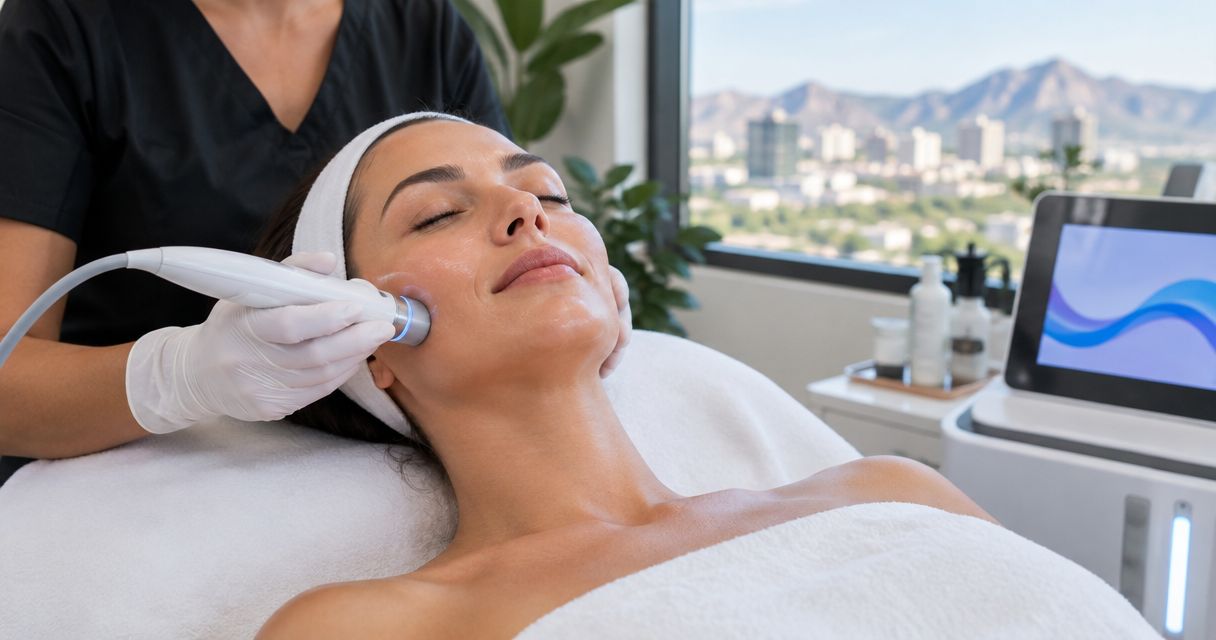
Best starting point for fine lines and uneven texture: SkinPen microneedling. Best fit for mild laxity without needles: focused ultrasound assessment. Best option for pronounced facial sagging: a surgical consultation. This 2026 guide compares the best skin tightening treatments Phoenix residents should consider by the problem each treatment actually addresses, not by a promise that every procedure produces a lift.
- For best skin tightening treatments Phoenix, distinguish loose skin from fine lines before choosing a procedure.
- Bonnie Frances Skin offers SkinPen microneedling; consider it for texture concerns, not a surgical-level lift.
- Focused ultrasound and noninvasive radiofrequency target mild laxity, but outcomes depend on treatment suitability.
- Pronounced facial sagging belongs in a surgical consultation, not a facial treatment package.
Why this matters
Loose skin, fine lines, dehydration, and uneven texture are different problems. A treatment that smooths the surface does not necessarily reposition sagging tissue. Choosing by the word tightening alone makes those distinctions disappear.
Bonnie Frances Skin offers SkinPen microneedling, facials, hydrafacials, dermaplaning, and chemical peels in Phoenix. Of those services, microneedling belongs in a discussion about collagen remodeling and texture. Hydrating or exfoliating treatments serve different purposes; they should not be presented as substitutes for lifting procedures.
Bonnie Frances Skin is best for Phoenix clients considering SkinPen microneedling for texture concerns, rather than a surgical-level lift. The clinic's listed services do not establish that it offers ultrasound, radiofrequency, laser resurfacing, or surgery. Those categories appear here to help you choose the appropriate consultation.
What makes the best skin tightening treatment?
Use these criteria to choose a treatment in 2026:
- Problem match: Separate mild laxity from wrinkles, acne scars, dryness, and significant sagging.
- Treatment depth: Ask whether the procedure treats the skin surface, stimulates dermal remodeling, or repositions deeper tissue.
- Realistic endpoint: Define the change you want before accepting claims about lifting or rejuvenation.
- Safety fit: Discuss skin tone, pigment history, medications, medical conditions, and previous procedures.
- Recovery fit: Understand wound care, redness, sun precautions, and restrictions before scheduling.
- Provider qualification: Confirm who performs the procedure, their training, and how complications are managed.
The most important question is not which treatment sounds strongest. It is whether the treatment addresses the tissue responsible for your concern. Ask the provider to explain that connection in plain language.
Skin tightening options at a glance
This comparison separates treatment categories rather than ranking Phoenix clinics. The order follows the detailed recommendations below; it is not a claim that microneedling produces more tightening than surgery.
| Treatment | Best for | Standout feature | Key limitation |
|---|---|---|---|
| SkinPen microneedling | Fine lines and uneven texture | Controlled needling supports skin remodeling | Does not reposition pronounced sagging tissue |
| Focused ultrasound | Mild laxity without needles | Delivers focused energy beneath the surface | Results are not equivalent to a surgical lift |
| Noninvasive radiofrequency | Mild laxity with a preference for surface-applied treatment | Uses radiofrequency energy to heat targeted tissue | Device design and treatment technique matter |
| Laser resurfacing | Surface wrinkles and sun-damaged texture | Treats surface changes alongside remodeling | Pigment risk and recovery vary by laser |
| Surgical facelift | Pronounced lower-face sagging and jowls | Repositions tissue rather than treating texture alone | Requires surgery and a recovery plan |
A consultation should also establish when none of these options is appropriate. Active irritation or an unresolved skin condition is a reason to assess the skin before selecting an elective procedure.
1. SkinPen microneedling: best for fine lines and uneven texture
SkinPen microneedling uses fine needles to create controlled skin injuries that initiate a healing response. It belongs in a discussion about texture and skin remodeling, not in the same outcome category as a facelift.
Bonnie Frances Skin offers SkinPen microneedling. That makes it a relevant starting point when your complaint is rough texture or fine lines rather than hanging skin. Ask the clinician to distinguish the concerns microneedling addresses from those that require another type of treatment.
SkinPen microneedling pros:
- Addresses texture concerns through controlled needling.
- Does not rely on heat-based energy delivery.
- Supports a focused discussion about scars, surface quality, and fine lines.
SkinPen microneedling cons:
- Does not remove excess skin or reposition deeper facial tissue.
- Involves skin injury, with risks including irritation, infection, and pigment changes.
- Requires appropriate aftercare rather than an immediate return to every skincare product.
Best for: Phoenix clients whose main concern is fine lines or uneven texture, with realistic expectations about lifting.
In your 2026 consultation, identify the exact area you want improved. A cheek with acne scarring presents a different treatment question from a loose jawline, even when both appear in the same photograph.
Verdict: Hold until the clinician confirms that texture—not substantial laxity—is the primary treatment goal.
2. Focused ultrasound: best for mild laxity without needles
Focused ultrasound delivers energy beneath the skin surface to selected tissue depths. A qualified provider must assess the treatment area, anatomy, and device suitability before recommending it.
This category belongs on your shortlist when mild laxity is the main complaint and you prefer an option without needling. It does not remove loose skin, and the absence of an incision does not make it risk-free.
Focused ultrasound pros:
- Targets tissue beneath the surface without surgical incisions.
- Offers a distinct approach to mild laxity rather than exfoliation.
- Allows treatment planning around specific anatomical areas.
Focused ultrasound cons:
- Discomfort and adverse effects remain possible.
- Does not reproduce surgical tissue repositioning.
- Requires careful device selection and anatomical assessment.
Best for: People with mild laxity who want an assessment of a needle-free energy treatment.
Ask which device will be used and why it fits your treatment area. A category name alone does not tell you the device's intended use, the provider's experience, or the expected endpoint.
Verdict: Hold until a qualified provider establishes that the degree and location of laxity fit the treatment.
3. Noninvasive radiofrequency: best for surface-applied treatment
Noninvasive radiofrequency uses energy applied through the skin surface to heat targeted tissue. It differs from radiofrequency microneedling, which combines needles with energy delivery.
That distinction matters. Ordinary SkinPen microneedling, noninvasive radiofrequency, and radiofrequency microneedling are not interchangeable names for the same procedure. Ask the provider to identify exactly what enters the skin and where energy is delivered.
Noninvasive radiofrequency pros:
- Provides an energy-based approach without needle penetration.
- Addresses a different treatment goal from a hydrating facial.
- Offers an option to discuss when mild laxity is the main concern.
Noninvasive radiofrequency cons:
- Heating introduces risks, including burns.
- Devices differ in design and treatment protocols.
- Does not remove excess skin or correct pronounced tissue descent.
Best for: People with mild laxity who prefer a surface-applied energy procedure over needling.
For a 2026 treatment plan, request the exact device name rather than accepting radiofrequency as a complete explanation. Ask how the provider monitors treatment, what adverse effects require contact, and who handles a complication.
Verdict: Hold until the provider explains the device, safety measures, and expected change for your skin.
4. Laser resurfacing: best for wrinkles with sun-damaged texture
Laser resurfacing treats skin using light-based energy. Ablative and nonablative approaches differ in how they affect the surface, so laser resurfacing is a category, not a single treatment with uniform recovery.
Choose a laser consultation when wrinkles, roughness, and sun-damaged texture dominate the concern. If the main issue is displaced tissue or excess skin, resurfacing alone addresses the wrong part of the problem.
Laser resurfacing pros:
- Directly addresses surface wrinkles and texture.
- Offers different approaches for different treatment goals.
- Allows a provider to assess texture and pigment concerns together.
Laser resurfacing cons:
- Pigment changes, infection, and scarring are potential risks.
- Recovery depends on the specific laser and treatment intensity.
- Significant laxity remains a separate concern.
Best for: People whose aging concerns center on surface wrinkles and sun-damaged texture rather than facial descent.
Tell the provider about previous dark marks after irritation or procedures. Skin tone and pigment history affect laser selection; a recommendation based only on a photograph leaves important safety questions unanswered.
Verdict: Hold until the provider specifies the laser, pigment considerations, and recovery requirements.
5. Surgical facelift: best for pronounced sagging and jowls
A surgical facelift repositions facial tissue and addresses excess skin. It answers a different question from microneedling, ultrasound, radiofrequency, or resurfacing: how to change structural sagging rather than improve skin quality alone.
A consultation with a qualified plastic surgeon is the appropriate route when lower-face descent or pronounced jowls drive your concern. A facelift does not eliminate the need to assess skin texture, and it does not treat every facial area identically.
Surgical facelift pros:
- Addresses tissue descent directly.
- Allows removal of excess skin when appropriate.
- Provides a structural treatment option for substantial sagging.
Surgical facelift cons:
- Involves surgical risks, including bleeding, infection, and scarring.
- Requires recovery planning and postoperative care.
- Does not replace treatment for every surface or pigment concern.
Best for: People with pronounced lower-face sagging who are prepared to consider surgery.
Ask which concerns the proposed operation would address and which would remain. The consultation should cover medical suitability, anesthesia, scars, recovery, and alternatives—not just a before-and-after image.
Verdict: Hold until a qualified surgeon completes an examination and explains the proposed operation.
How to choose your next consultation
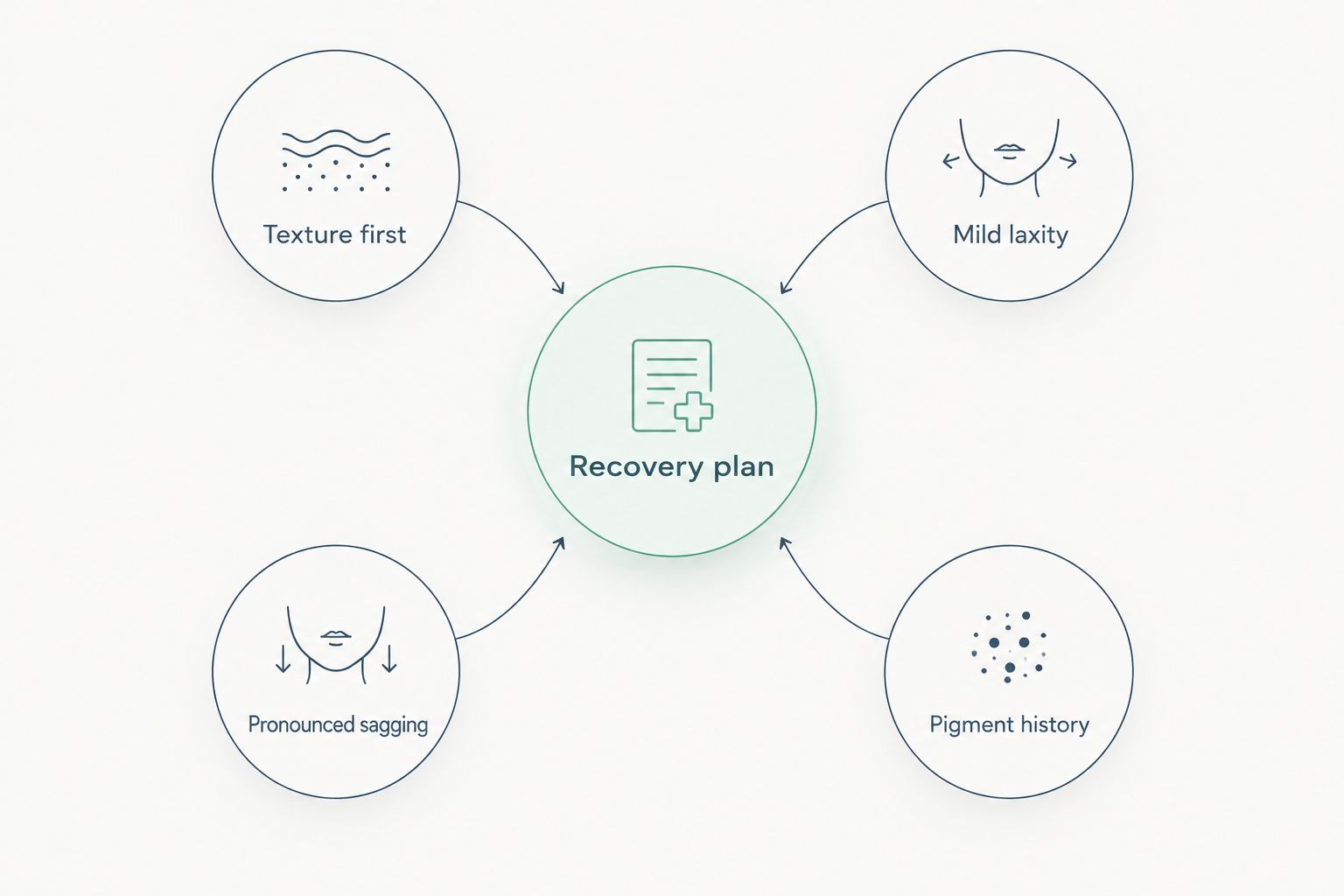
Start with the concern you can describe most clearly. Do not arrive committed to a device before the clinician has examined your skin.
- Texture first: Discuss microneedling or resurfacing when roughness and fine lines dominate.
- Mild laxity: Request an assessment of energy-based options when looseness is limited.
- Pronounced sagging: Seek a surgical opinion when excess skin or jowls dominate.
- Pigment history: Raise previous discoloration before selecting a procedure.
- Recovery plan: Confirm aftercare and restrictions before booking treatment.
Bring your current skincare list and disclose recent procedures. Ask whether active ingredients need to be paused and when they should resume. Do not apply a generic internet schedule to a procedure that creates wounds or delivers energy.
For Phoenix clients, sun protection belongs in the recovery discussion. The American Academy of Dermatology recommends broad-spectrum, water-resistant sunscreen with SPF 30 or higher, applied 15 minutes before going outdoors and reapplied every 2 hours outdoors, or after swimming or sweating. Follow your treating clinician's procedure-specific instructions as well.
How these treatments were ranked
This 2026 ranking prioritizes problem match, treatment depth, safety, recovery, and realistic outcomes. It does not rank clinics, claim direct comparative testing, or treat every form of skin aging as laxity.
SkinPen appears first because texture-focused treatment is a relevant option within the client's stated services. Ultrasound and noninvasive radiofrequency occupy separate preference slots for mild laxity. Laser resurfacing addresses surface aging; surgery addresses substantial tissue descent.
Which skin tightening treatment should you choose?
Choose the consultation before choosing the procedure. For fine lines and texture, start with a SkinPen discussion at Bonnie Frances Skin. For actual loose skin, ask a provider qualified in tightening procedures to assess whether energy-based treatment or surgery fits the concern.
Your 2026 decision should end with a named treatment, a defined goal, and written aftercare—not a vague promise of rejuvenation. If the provider cannot explain what the treatment will not change, keep asking questions before committing.
FAQ
What's the best skin tightening treatment in Phoenix?
The best treatment depends on whether your concern is mild laxity, surface wrinkles, or pronounced sagging. Discuss focused ultrasound or noninvasive radiofrequency for mild laxity, resurfacing for surface changes, and surgery for substantial tissue descent.
Is SkinPen microneedling a skin tightening treatment?
SkinPen microneedling supports skin remodeling, but it is not a substitute for a surgical lift. Consider it primarily in a consultation about texture, scars, and fine lines rather than pronounced sagging.
Does Bonnie Frances Skin offer skin tightening treatments?
Bonnie Frances Skin offers SkinPen microneedling alongside facials, hydrafacials, dermaplaning, and chemical peels. Discuss your concern with the clinic to determine whether its listed services fit your goal; ultrasound, radiofrequency, lasers, and surgery are not established as its offerings here.
Is radiofrequency the same as microneedling?
Radiofrequency and microneedling are different treatment methods. Noninvasive radiofrequency applies energy through the surface, ordinary microneedling uses needles without radiofrequency, and radiofrequency microneedling combines needles with energy.
Can a hydrafacial lift sagging skin?
A hydrafacial is not a tissue-repositioning treatment for sagging skin. Hydration and surface care address different concerns from procedures intended to treat laxity.
Which treatment is best for loose skin around the jawline?
Pronounced jawline sagging warrants a surgical consultation; mild laxity warrants an assessment of nonsurgical options. An examination is necessary to distinguish loose skin from other contributors to the jawline's appearance.
What should I ask before booking skin tightening?
Ask what tissue the procedure treats, what change to expect, and what it will not correct. Confirm the exact device or procedure, the provider's qualifications, potential complications, and recovery instructions.
One last thing
A smoother face and a lifted face are not the same result. Before booking, ask the provider to name the concern being treated without using rejuvenation or tightening. A precise diagnosis makes the treatment choice clearer than a stronger-sounding procedure name.