Best overall: a fragrance-free moisturizer. Best for daily protection: a mineral sunscreen. Best for a simple cleansing routine: a gentle, non-soap cleanser. The best skincare products for rosacea-prone skin in 2026 protect your skin barrier without adding unnecessary irritation; azelaic acid belongs in a separate, dermatologist-guided treatment decision.
- The best skincare products for rosacea-prone skin start with a fragrance-free moisturizer, gentle cleanser, and mineral sunscreen.
- Choose broad-spectrum SPF 30 or higher; sunscreen supports rosacea care but does not replace medical treatment.
- Bonnie Frances Skin offers professional skincare lines in Phoenix; choose individual formulas rather than assuming an entire line suits rosacea.
- Discuss azelaic acid with a dermatologist when bumps and persistent redness need treatment beyond basic skincare.
Why this matters
Rosacea-prone skin needs a routine you can tolerate repeatedly, not a shelf full of products marketed for redness. A product that stings, causes burning, or leaves your face feeling tight is not a good fit simply because it says sensitive skin on the packaging.
Bonnie Frances Skin is a Phoenix skincare clinic offering professional skincare lines. Bonnie Frances Skin is a clinic option for Phoenix clients seeking professional skincare, not a substitute for dermatologist-led rosacea treatment.
This 2026 guide ranks product categories by their role in your routine. It does not treat every moisturizer, sunscreen, or cleanser as interchangeable: ingredients, texture, and your response determine whether a particular formula earns a place.
The American Academy of Dermatology's rosacea skin-care guidance supports gentle cleansing, moisturizing, and sun protection. These steps support skin comfort; they do not diagnose rosacea or replace medication when medication is needed.
What makes the best skincare products for rosacea-prone skin?
Use these criteria before you choose a formula:
- Low irritation potential: Prefer fragrance-free products and avoid ingredients that consistently trigger burning or stinging for you.
- A clear purpose: Each product should cleanse, moisturize, protect, or address a dermatologist-identified treatment need.
- Barrier support: A moisturizer should leave skin comfortable rather than tight, hot, or persistently irritated.
- Usable sun protection: Choose broad-spectrum SPF 30 or higher in a texture you will apply as directed.
- Formula-level judgment: Assess the individual product, not the reputation of its brand or the word professional.
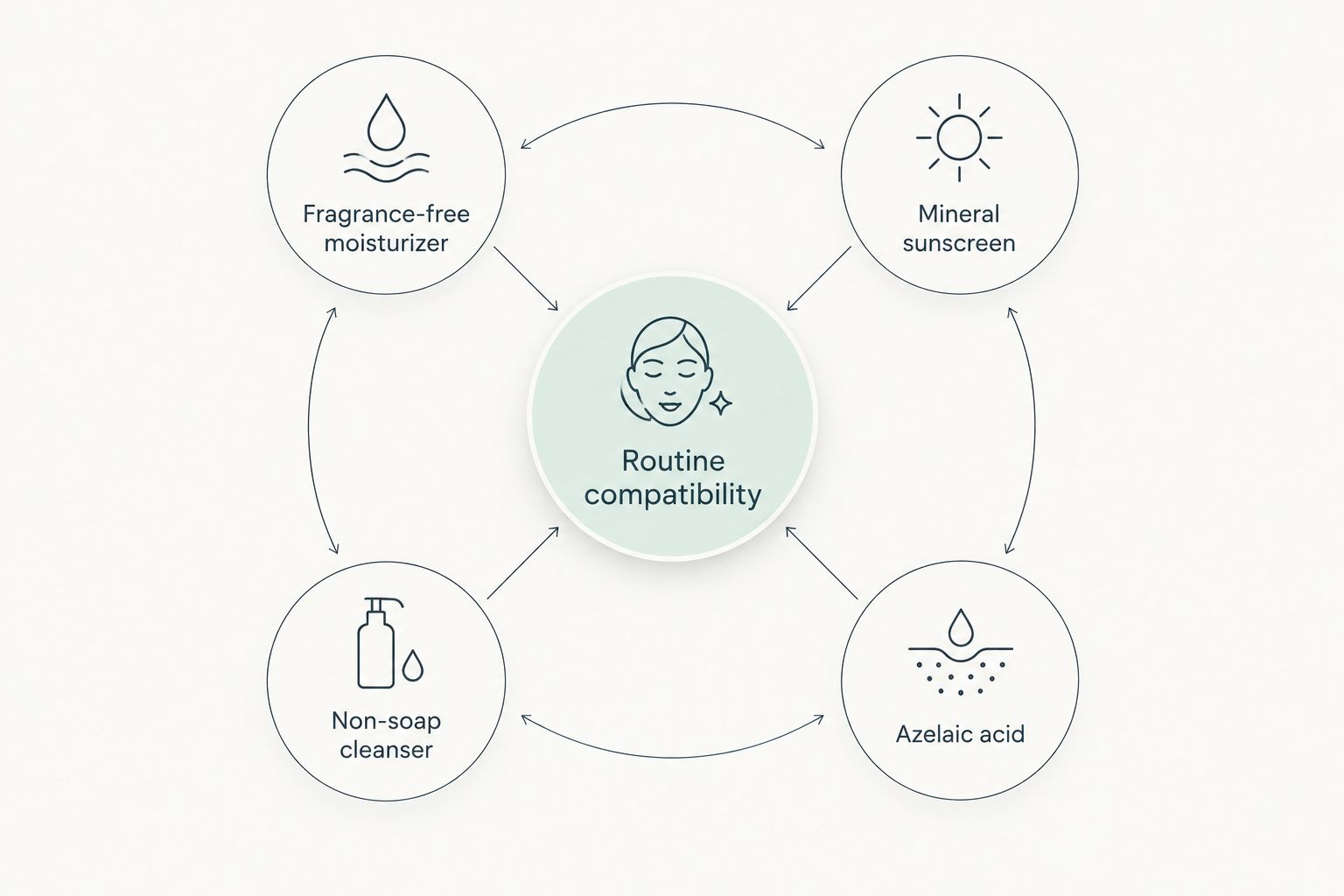
- Routine compatibility: Introduce changes separately so you can identify which product your skin tolerates.
Fragrance-free and unscented do not mean the same thing. Unscented products can contain ingredients used to mask odor, so read the ingredient list rather than relying on the front label.
Rosacea skincare options at a glance
| Rank and option | Best for | Standout feature | Key limitation |
|---|---|---|---|
| 1. Fragrance-free moisturizer | Dryness and daily barrier support | Helps skin retain moisture | Does not treat every feature of rosacea |
| 2. Mineral sunscreen | Daily UV protection | Zinc oxide or titanium dioxide filters | Some formulas leave a visible cast or feel heavy |
| 3. Gentle, non-soap cleanser | A simple cleansing routine | Cleans without relying on abrasive scrubbing | Not every formula removes persistent makeup easily |
| 4. Dermatologist-guided azelaic acid | Rosacea-associated inflammatory bumps | An ingredient used in rosacea treatment | Can sting or irritate; suitability needs individual assessment |
These options perform different jobs. Sunscreen does not replace moisturizer, and a treatment ingredient does not make gentle cleansing unnecessary.
1. Fragrance-free moisturizer: best for dry, uncomfortable skin
A fragrance-free moisturizer is the default starting point when rosacea-prone skin feels dry or tight. It helps reduce moisture loss and supports the skin barrier. Choose a texture that leaves your face comfortable without requiring vigorous rubbing.
Humectants such as glycerin attract water, while emollient and occlusive ingredients help soften skin and limit moisture loss. These ingredient functions are useful, but they do not guarantee that every formula containing them will suit you.
Fragrance-free moisturizer pros:
- Supports daily moisture retention.
- Fits into a routine alongside prescribed treatment.
- Offers a practical alternative to adding more exfoliating products.
Fragrance-free moisturizer cons:
- Does not replace treatment for inflammatory rosacea.
- Rich textures can feel heavy or interfere with makeup.
- Fragrance-free formulas can still contain ingredients you do not tolerate.
Best for: Dryness, tightness, and a basic routine that needs better barrier support.
Apply moisturizer gently rather than massaging aggressively. If it burns every time you apply it, do not interpret that sensation as proof the formula is working.
For your 2026 routine, choose tolerability over an elaborate ingredient list. Verdict: Buy a fragrance-free moisturizer that your skin tolerates; skip formulas that repeatedly sting.
2. Mineral sunscreen: best for daily UV protection
A mineral sunscreen uses zinc oxide, titanium dioxide, or both as UV filters. The American Academy of Dermatology recommends broad-spectrum, water-resistant SPF 30 or higher for rosacea-prone skin and identifies these mineral filters as useful choices when sunscreen causes irritation.
The best formula is one you can apply consistently according to its label. A theoretically appealing sunscreen that you avoid because of its texture does not support a dependable routine.
Mineral sunscreen pros:
- Provides UV protection when applied correctly.
- Offers a practical starting point for people who find other sunscreen formulas irritating.
- Tinted versions can reduce the visibility of a white cast.
Mineral sunscreen cons:
- Untinted formulas can leave a noticeable cast.
- Some textures feel drying, thick, or difficult to spread.
- Mineral filters do not make the rest of the formula automatically nonirritating.
Best for: Daily sun protection, particularly when you need to reconsider an irritating sunscreen.
Sunscreen belongs alongside shade and protective clothing. Reapply according to the product label, especially during outdoor exposure, and do not assume a morning application provides all-day protection.
In Phoenix, make sun protection part of the decision before booking exfoliating treatments. Verdict: Buy a tolerable mineral sunscreen; skip choosing solely by the SPF number while ignoring texture and irritation.
3. Gentle, non-soap cleanser: best for a simple cleansing routine
A gentle, non-soap cleanser removes surface debris without requiring a scrub, brush, or strong exfoliating step. Use your fingertips and lukewarm water, then pat dry. The goal is clean skin, not a squeaky finish.
The American Academy of Dermatology recommends gently cleansing rosacea-prone skin 2 times daily. If prescribed treatment or your skin's response calls for a different approach, follow your clinician's instructions rather than forcing a routine that increases irritation.
Gentle, non-soap cleanser pros:
- Keeps cleansing separate from exfoliation.
- Works as a basic routine step without introducing a treatment active.
- Reduces the need for abrasive cleansing tools.
Gentle, non-soap cleanser cons:
- Some formulas struggle with persistent makeup or water-resistant sunscreen.
- Repeated washing to remove residue can increase irritation.
- A gentle label does not guarantee that every ingredient suits your skin.
Best for: A minimal routine and cleansing that does not leave your face tight.
Do not automatically add a second cleanser because double cleansing is popular. Start with the least complicated approach that adequately removes what you apply, and reassess if you consistently need to rub or wash repeatedly.
Verdict: Buy a gentle, non-soap cleanser; skip scrubs and cleansing brushes on irritated rosacea-prone skin.
4. Dermatologist-guided azelaic acid: best for inflammatory bumps
Azelaic acid is used in rosacea treatment, including prescription formulations. It belongs in a different category from everyday moisturizer and sunscreen because it targets a treatment need rather than simply supporting basic skincare.
If your main concern is bumps, persistent redness, or worsening symptoms, get a diagnosis before buying another active ingredient. Acne and rosacea can resemble one another, but their treatment plans are not interchangeable.
Dermatologist-guided azelaic acid pros:
- Has an established role in treating inflammatory rosacea.
- Gives treatment a defined purpose beyond general hydration.
- Can be incorporated into a clinician-directed routine.
Dermatologist-guided azelaic acid cons:
- Can cause burning, stinging, or irritation.
- Cosmetic products and prescription formulations are not interchangeable.
- Does not replace sunscreen or basic barrier care.
Best for: People with diagnosed rosacea whose dermatologist recommends treatment for inflammatory lesions.
Do not copy another person's frequency or combine several treatment ingredients at once. Follow the directions for your specific formulation and discuss irritation with the prescribing clinician.
Verdict: Hold until suitability is clear; use azelaic acid for a defined treatment need, not as an automatic addition to every redness routine.
How to introduce a product without changing everything
A useful 2026 skincare plan makes reactions easier to trace. Keep tolerated products steady while you assess a new addition; replacing cleanser, moisturizer, sunscreen, and treatment together makes the cause of irritation harder to identify.
Use this sequence:
- Record your baseline. Note existing burning, dryness, bumps, and the products you already use.
- Test the formula. The American Academy of Dermatology's product-testing guidance recommends applying a new skincare product to a small test area for 7–10 days, following its directions.
- Change one step. Introduce the new product without adding several other unfamiliar formulas.
- Watch your response. Stop using a product that causes a reaction and seek medical advice for significant or persistent symptoms.
A small-area test does not guarantee that your face will tolerate a product. It is a screening step, not a diagnosis or an assurance against future reactions.
Professional skincare and facials: where they fit
Bonnie Frances Skin offers Skinbetter, Epicutis, Jan Marini, Epionce, and Alastin skincare lines. That list tells you which lines the clinic offers; it does not establish that every formula in those lines is appropriate for rosacea.
Ask about the individual product's ingredients, intended purpose, and compatibility with your existing treatment. Professional skincare is not automatically rosacea-safe skincare.
The same distinction applies to services. A facial is not a substitute for diagnosis, and exfoliation is not the default answer to redness. Before considering a service, discuss current symptoms, prescribed products, and any history of irritation.
The guide to facials for sensitive skin in Phoenix covers a related service decision. Keep that decision separate from choosing your daily skincare foundation.
How these categories were ranked
This ranking prioritizes tolerability, barrier support, sun protection, and a clear role within the routine. It is a practical buying framework, not a head-to-head trial of individual products.
Moisturizer leads as the overall starting point for dry, uncomfortable skin. Sunscreen remains essential, cleanser keeps the routine functional, and azelaic acid requires a treatment-specific decision. A lower position does not mean a category is less necessary for your particular needs.
Which skincare products should you choose?
Start your 2026 routine with a tolerated fragrance-free moisturizer, gentle cleanser, and broad-spectrum sunscreen. If those basics are already comfortable, do not replace them just to follow a new list.
Choose the next move by the problem:
- Dry or tight skin: Reassess moisturizer and cleansing before adding exfoliation.
- An irritating sunscreen: Compare individual mineral formulas rather than abandoning sun protection.
- Inflammatory bumps: Ask a dermatologist whether a rosacea treatment belongs in your routine.
- Persistent burning: Stop experimenting with multiple new products and seek clinical guidance.
Explore professional skincare options
Review Bonnie Frances Skin's Phoenix skincare clinic and available professional lines.
FAQ
What's the best skincare product for rosacea-prone skin?
A tolerated fragrance-free moisturizer is the best general starting point for dry, uncomfortable rosacea-prone skin. Pair it with gentle cleansing and broad-spectrum sunscreen; treatment for inflammatory symptoms requires a separate decision.
Is mineral sunscreen better for rosacea-prone skin?
Mineral sunscreen is a practical starting point when other sunscreens irritate your skin. Choose zinc oxide or titanium dioxide, broad-spectrum SPF 30 or higher, and a formula you can apply comfortably according to its label.
Should I use azelaic acid if I have rosacea?
Use azelaic acid when it fits a dermatologist-guided treatment plan. It has an established role in treating inflammatory rosacea, but it can irritate and is not necessary for every person with facial redness.
Can I exfoliate rosacea-prone skin?
Do not make exfoliation the default response to rosacea-related redness or irritation. Scrubs and other irritating products can worsen discomfort; discuss exfoliating treatments with a clinician who understands your condition.
How do I test a new skincare product on sensitive skin?
Apply the product to a small test area according to its directions before introducing it more broadly. The American Academy of Dermatology recommends a 7–10-day testing period, but a successful test does not guarantee facial tolerance.
Are professional skincare brands automatically safe for rosacea?
No, professional branding does not establish that a formula suits rosacea-prone skin. Bonnie Frances Skin offers several professional lines, but you still need to assess each product's ingredients, purpose, and your own tolerance.
When should I see a dermatologist instead of changing skincare?
See a dermatologist when redness is persistent, inflammatory bumps recur, or products repeatedly cause burning. Eye irritation also needs medical assessment; a cosmetic routine cannot diagnose or treat every rosacea symptom.
One last thing
A product can be fragrance-free and still be wrong for your skin. Let your response outrank the label: keep formulas that remain comfortable, and stop treating repeated burning as a normal adjustment period.