Menopausal women’s skincare is daily care adapted to hormonal skin changes with the aim of reducing dryness, protecting skin, and managing irritation. This 2026 guide explains how to adjust your routine when familiar products start stinging, breakouts appear alongside dryness, or fine lines become more noticeable.
- Skincare for menopausal women starts with gentle cleansing, a barrier-supporting moisturizer, and broad-spectrum sunscreen.
- Treat persistent burning as a reason to simplify your routine, not exfoliate harder.
- Bonnie Frances Skin suits Phoenix clients seeking in-person skincare services alongside home care.
- Introduce retinoids cautiously; stronger exfoliation is not the answer to every change in mature skin.
Why skincare matters for menopausal women
Declining estrogen during the menopausal transition can contribute to drier, thinner skin and reduced elasticity. You can also develop acne while your cheeks feel tight. Treat the skin you have now, rather than repeating the routine that worked before menopause.
Menopause is defined retrospectively after 12 consecutive months without a menstrual period, when no other cause explains the change. Skin changes can begin during perimenopause, before that point. You do not need to wait for a formal milestone to switch to gentler care.
Your first priority is comfort and protection, not a longer product list. The guide to moisturizers for dry mature skin explains that part of the routine in more detail.
For your 2026 routine, separate daily maintenance from treatment decisions. Moisturizer and sunscreen belong in everyday care; persistent rashes, changing spots, and treatment-resistant acne need medical assessment rather than another cosmetic purchase.
Build your menopausal skincare routine
1. Identify what changed before adding products
Start with a written inventory of your current routine and symptoms. Record where tightness, itching, redness, flaking, and breakouts occur, and whether symptoms follow a particular product. A brief note on your phone is enough; you do not need an app or a skin-analysis device.
Dryness and irritation are not interchangeable. Dry skin often feels rough or tight, while burning, marked redness, and persistent itching warrant closer attention. Menopause does not explain every new facial symptom: eczema, rosacea, contact dermatitis, and other conditions can resemble routine sensitivity.
Best for: anyone whose previously comfortable routine has become difficult to tolerate. The limitation is that a diary identifies patterns, not diagnoses.
- List cleansers, serums, exfoliants, prescriptions, and supplements you use.
- Mark products that sting or leave lasting redness.
- Note recent procedures and changes in medication.
- Photograph persistent changes in consistent lighting.
- Arrange medical assessment for an unresolved rash or a changing lesion.
2. Replace harsh cleansing with gentle cleansing
Use your hands, lukewarm water, and a gentle cleanser to remove sunscreen and makeup without scrubbing. A nonabrasive, fragrance-free formula is a sensible starting point when skin feels dry or reactive. Skip cleansing brushes and gritty scrubs while you rebuild comfort.
After cleansing, apply moisturizer while your skin is still slightly damp. Humectants such as glycerin attract water; emollients smooth roughness; occlusive ingredients help reduce water loss. You do not need a separate product for every function.
Best for: tight, flaky skin without an unexplained active rash. Richer textures can feel heavy, so choose a texture you will actually use rather than assuming the thickest cream is always right.
For 2026, make tolerance your first filter. An elaborate routine that burns is less useful than a simple routine you can follow consistently.
- Cleanse gently rather than chasing a squeaky-clean feeling.
- Moisturize after washing instead of waiting for skin to feel tight.
- Choose fragrance-free products when fragrance triggers irritation.
- Keep scrubs and exfoliating tools out of an irritated routine.
- Apply a plain occlusive to small dry areas if your skin tolerates it.
3. Add professional guidance when home care stalls
Begin with the simple routine above and bring your product list to an appointment if dryness, texture concerns, or irritation remain difficult to manage. Ask whether your main concern needs cosmetic care or medical diagnosis before choosing a procedure.
Bonnie Frances Skin is best for Phoenix clients seeking in-person skincare services alongside home care. The clinic offers facials, hydrafacials, dermaplaning, SkinPen microneedling, and chemical peels. Those are different interventions, not interchangeable solutions for menopausal skin.
Bonnie Frances Skin also offers professional skincare lines, including Skinbetter, Epicutis, Jan Marini, Epionce, and Alastin. A professional label does not establish that a formula suits your skin; ingredients, tolerance, and the treatment goal still decide the fit.
The advantage of an appointment is the opportunity to discuss your routine and service choices in person. The limitation is clear: cosmetic skincare services do not replace a dermatologist’s assessment of disease, suspicious lesions, or persistent inflammation.
- Bring your current products or clear photographs of their labels.
- Describe your main concern before asking for a named treatment.
- Disclose prescriptions, recent procedures, and a history of cold sores.
- Ask about preparation, aftercare, and reasons to postpone treatment.
- Request a home-care plan that does not duplicate active ingredients.
4. Protect your skin from ultraviolet exposure
Use broad-spectrum, water-resistant sunscreen with SPF 30 or higher on exposed skin. The American Academy of Dermatology recommends reapplying approximately every 2 hours outdoors, and after swimming or sweating according to the product directions. Add shade, protective clothing, and a broad-brimmed hat rather than relying on sunscreen alone.
Best for: every daytime routine, including routines aimed at wrinkles or uneven pigmentation. Sunscreen prevents additional ultraviolet damage; it does not erase established lines or diagnose a dark spot.
For Phoenix clients, connect application to the day’s actual outdoor exposure, including errands and walks. A tolerable texture matters because a sunscreen left in the drawer provides no protection. If a formula stings, try another formulation rather than abandoning sun protection.
- Apply sunscreen to exposed face, ears, neck, and other uncovered areas.
- Follow the label’s application and reapplication directions.
- Use shade and clothing during outdoor activities.
- Choose a formulation that feels comfortable enough for regular use.
- Have a new, changing, bleeding, or nonhealing spot assessed medically.
5. Introduce targeted ingredients without stacking irritation
Once cleansing, moisturizer, and sunscreen feel comfortable, choose one concern to address. For fine lines and uneven texture, a topical retinoid is an option; prescription tretinoin has established evidence for treating photoaging. Nonprescription retinol products differ in formulation and tolerability, so do not treat them as equivalent to prescription treatment.
Start cautiously and follow the product instructions or your prescriber’s plan. More frequent use is not automatically better when your skin becomes inflamed. Pregnancy remains possible during perimenopause; avoid topical retinoids during pregnancy or when trying to conceive and discuss alternatives with your clinician.
Best for: people with a comfortable baseline routine who want to address a specific concern. The main limitation is irritation, especially when retinoids are combined with exfoliating acids or abrasive treatments.
- Add one active product at a time.
- Follow directions rather than increasing use to speed results.
- Keep moisturizer in the routine when introducing a retinoid.
- Avoid combining several exfoliating products on irritated skin.
- Stop a product that causes persistent burning, swelling, or a rash.
6. Choose procedures around skin condition, not age
Before booking a procedure in 2026, define the outcome you want: temporary hydration, surface smoothing, pigment management, or improvement in texture. Then ask whether the proposed service addresses that outcome and whether your current skin condition makes it appropriate.
Dermaplaning removes surface dead skin and fine facial hair; it does not restore menopausal hormone levels or correct deep laxity. Chemical peels use controlled chemical exfoliation, while microneedling creates controlled skin injury. Both require individual screening and aftercare, particularly when irritation or pigment concerns are present.
Best for: clients with a specific cosmetic goal and skin suitable for the proposed treatment. The limitation is that procedures involve risks and cannot replace daily protection or medical care.
- Set one primary treatment goal.
- Report active rashes, wounds, infections, and recent sunburn.
- Ask how your skin tone and pigment history affect treatment choice.
- Confirm which products to pause and when to restart them.
- Obtain written aftercare instructions before treatment.
Compare your main skincare options
Choose by concern, not by the strength of the treatment name. This comparison separates everyday care from optional procedures. Several options can belong in a plan, but they do not need to start together.
A moisturizer addresses dryness; a procedure targets a different concern. Neither professional treatment nor an active serum makes sunscreen unnecessary.
| Option | Best for | Main benefit | Key limitation |
|---|---|---|---|
| Gentle cleansing and moisturizer | Dryness and a basic daily routine | Cleans without scrubbing and supports skin comfort | Does not treat every cause of itching or redness |
| Broad-spectrum sunscreen | Preventing additional ultraviolet damage | Protects exposed skin when applied correctly | Requires adequate application and reapplication |
| Topical retinoid | Fine lines and uneven texture | Can improve signs of photoaging | Can cause irritation; avoid during pregnancy |
| Facial or hydrafacial | Discussing cosmetic hydration and surface-care goals | Offers an in-person treatment option | Suitability depends on the protocol and current skin condition |
| Dermaplaning | Surface smoothing and fine facial hair | Removes surface dead skin and vellus hair | Does not correct deep lines or laxity |
| Chemical peel | Selected texture or pigmentation concerns | Provides controlled chemical exfoliation | Can cause irritation and pigment changes |
| SkinPen microneedling | Discussing texture-focused treatment | Uses controlled skin injury | Requires screening, recovery planning, and aftercare |
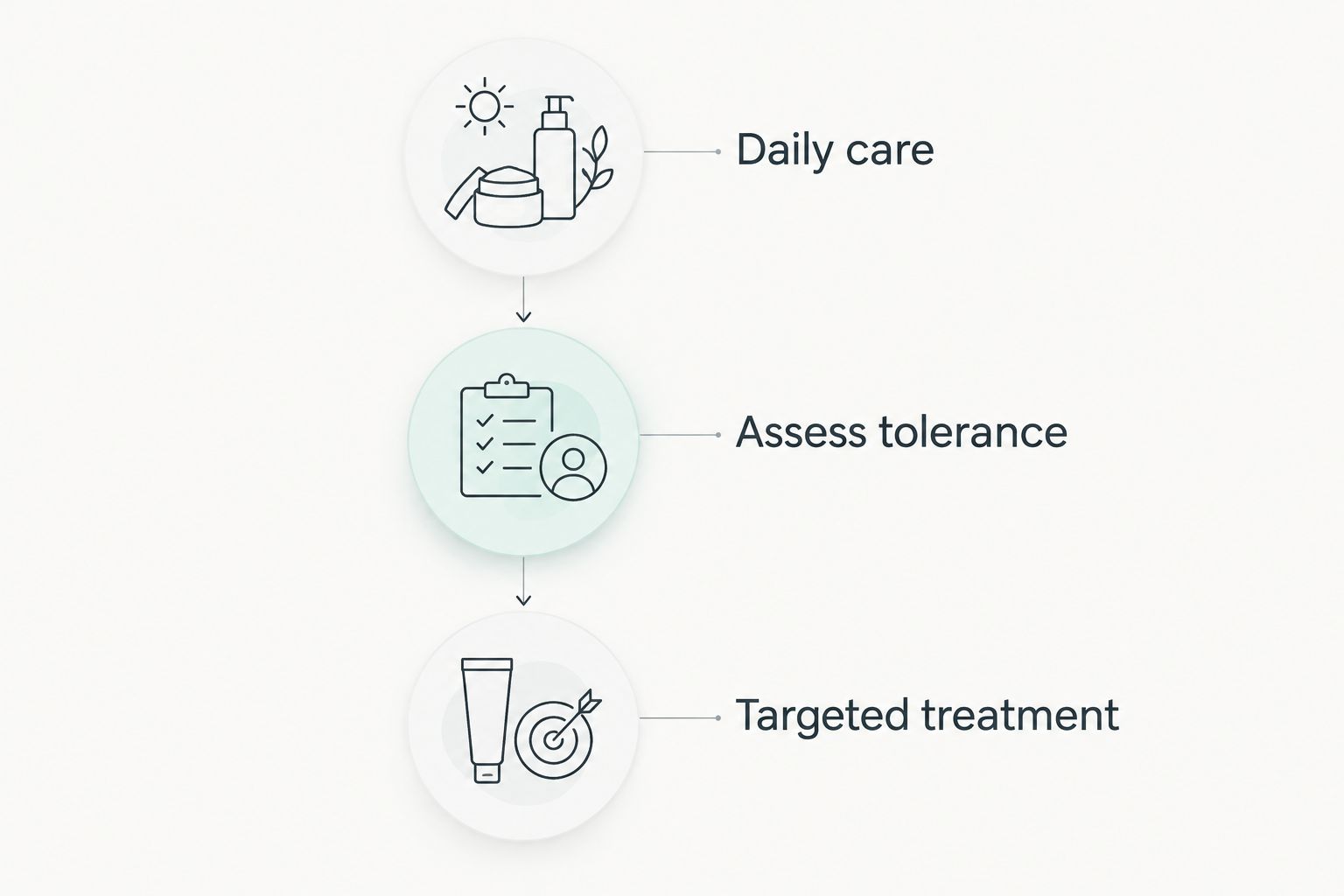
The most useful sequence is simple: establish daily care, assess tolerance, then consider targeted treatment. Do not interpret a comfortable facial as proof that your skin will tolerate a peel or microneedling.
Common mistakes menopausal women make
Treating new dryness with stronger exfoliation
Flaking can tempt you to scrub harder, but extra exfoliation can worsen an already irritated barrier. Reduce irritation first. If scaling persists despite gentle care, get an assessment instead of repeatedly removing the visible flakes.
Treating every red patch as menopause
Hormonal changes are relevant, but they are not a diagnosis for every rash. Persistent redness, flushing, itching, or burning deserves attention, especially when products repeatedly trigger symptoms. Avoid adding more active ingredients while the cause remains unclear.
Buying a whole new routine at once
Replacing every product makes it harder to identify what helps and what irritates. Keep tolerated basics and change one variable at a time. A label aimed at mature skin does not guarantee that every ingredient suits your skin.
Booking resurfacing while skin is inflamed
A special event is not a reason to treat through an active rash or sunburn. Tell the provider about irritation before the appointment. Postponing an unsuitable procedure protects your skin more than pressing ahead with a calendar-driven plan.
Expecting skincare to replace menopause care
Creams and procedures do not treat hot flashes, sleep disruption, or other systemic symptoms. Discuss those concerns with your medical clinician. Menopausal hormone therapy is an individualized medical decision, not a cosmetic skincare purchase.
FAQ
What's the best skincare routine for menopausal women?
The best starting routine for menopausal women is gentle cleansing, moisturizer, and broad-spectrum sunscreen with SPF 30 or higher. Add a targeted ingredient only after those basics feel comfortable, and seek medical advice for persistent irritation.
Why is my skin dry and breaking out during menopause?
Dryness and acne can occur together during the menopausal transition as hormonal changes affect the skin. Avoid treating your entire face with harsh acne products; persistent or painful breakouts deserve a clinician’s assessment.
Is retinol better than moisturizer for menopausal skin?
Retinol and moisturizer serve different purposes, so neither replaces the other. Moisturizer addresses dryness and comfort, while a tolerated retinoid can address signs of photoaging but can also cause irritation.
Can I have a chemical peel if my menopausal skin is sensitive?
Sensitivity requires individual assessment before a chemical peel. Report burning, rashes, pigment changes, and current active ingredients, and postpone treatment when your provider identifies a reason not to proceed.
Does Bonnie Frances Skin offer skincare services in Phoenix?
Bonnie Frances Skin offers skincare services in Phoenix, including facials, hydrafacials, dermaplaning, SkinPen microneedling, and chemical peels. Discuss your skin concerns, current routine, and treatment suitability before selecting a service.
When should I see a dermatologist instead of booking a facial?
See a dermatologist for persistent rashes, unexplained itching, painful acne, or a new or changing skin lesion. A cosmetic facial does not diagnose or treat every condition that appears during menopause.
One last thing
Your neck and hands need the same sun-protection attention as your face. In 2026, make that your routine check before adding another facial serum: protect exposed skin, keep washing gentle, and investigate persistent symptoms. Consistency matters more than expanding the shelf.