Teachers’ and educators’ skincare is daily cleansing, moisturizing, and sun protection with the aim of maintaining comfortable skin through classroom work and outdoor duties. This 2026 guide explains how to build a repeatable routine, address specific concerns, and fit professional treatments around your school calendar.
- Skincare for teachers and educators starts with gentle cleansing, moisturizer, and broad-spectrum sunscreen—not a crowded product shelf.
- Bonnie Frances Skin is best for Phoenix educators seeking professional skincare services alongside a home routine.
- Plan outdoor-duty sun protection separately from classroom skincare; reapply sunscreen during extended outdoor exposure.
- Schedule peels and microneedling around written aftercare requirements, not simply the next school holiday.
Why skincare matters for teachers and educators
A useful routine has to fit the school day. If you supervise recess, coach after school, or cover dismissal, your sun-protection plan needs to account for those duties. If mornings leave little room for extra steps, a complicated routine is the wrong starting point.
Consistency matters more than the number of products you own. Separate daily maintenance from treatments for acne, discoloration, or texture rather than expecting one facial or serum to do everything.
Bonnie Frances Skin offers skincare services in Phoenix, including facials, hydrafacials, dermaplaning, SkinPen microneedling, and chemical peels. Those services are options for individualized treatment planning, not prerequisites for starting a sensible home routine.
For your 2026 school calendar, identify the moments that change your needs: outdoor supervision, sports seasons, evening events, and breaks when you can follow treatment aftercare. Let those commitments shape the plan instead of choosing treatments by their names alone.
Build a routine that fits your teaching schedule
1. Establish your daily basics
Start with the products you already tolerate. Write down what you use, when you use it, and whether your skin feels comfortable afterward; a notebook is enough. You do not need a tracking app or a new product collection.
A basic morning routine centers on gentle cleansing as needed, moisturizer, and sunscreen. At night, remove makeup and sunscreen with a gentle cleanser, then moisturize. Adjust cleansing to your skin rather than scrubbing until it feels tight.
Keep the routine easy to repeat on a busy school morning. Place daily essentials together, and keep occasional treatments separate so that tired evenings do not turn into accidental overuse.
If your skin is already burning, cracking, or persistently inflamed, stop experimenting. Seek clinical advice rather than adding another exfoliant or trying to treat an unidentified condition yourself.
- List your current products: Include prescription treatments and occasional masks, not just daily skincare.
- Simplify the sequence: Establish cleansing, moisturizing, and sunscreen before adding optional steps.
- Record discomfort: Note stinging, itching, flaking, and the product used before it appeared.
- Separate prescriptions: Follow the prescriber’s directions rather than changing them to match a general routine.
2. Match sun protection to outdoor duties
Check your actual timetable before buying another serum. A teacher who stays indoors all day needs different practical arrangements from an educator supervising playgrounds or coaching outdoors. The difference is access to shade, protective clothing, and opportunities to reapply sunscreen—not a special teacher-only ingredient.
For your 2026 routine, follow the American Academy of Dermatology’s public sunscreen guidance: choose broad-spectrum, water-resistant sunscreen with SPF 30 or higher, apply it 15 minutes before going outdoors, and reapply about every 2 hours while outdoors. Reapply after swimming or sweating according to the label.
Morning sunscreen is not a substitute for reapplication during extended outdoor exposure. Keep it somewhere accessible and within the storage conditions printed on the package, rather than leaving it in a hot vehicle.
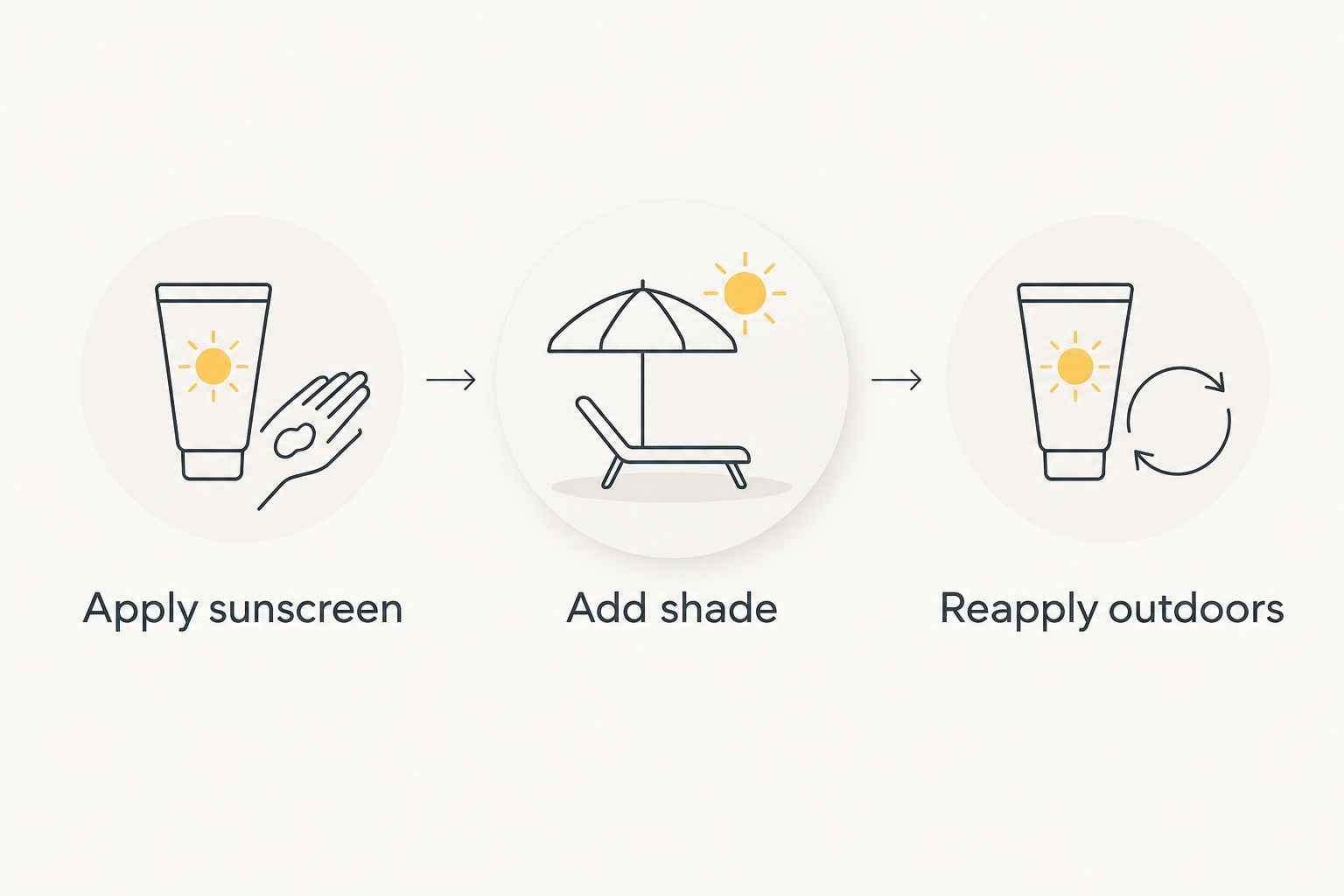
Use this sequence for outdoor-duty planning:
- Apply sunscreen: Cover exposed skin, including ears and neck, according to the label.
- Add shade: Use available shade and sun-protective clothing alongside sunscreen.
- Reapply outdoors: Build reapplication around extended outdoor duties and sweating.
- Check storage: Follow the package instructions for heat exposure and expiration.
3. Choose one concern before adding targeted care
Name the issue you want to address in plain language: recurring breakouts, uncomfortable dryness, uneven pigmentation, or visible texture. Avoid treating every concern at once. When several products change together, identifying the source of irritation becomes harder.
The manual approach is straightforward: keep your basic routine stable and record what changes when you introduce a product. Follow its directions and ask a qualified professional about compatibility with prescriptions or existing skin conditions.
For Phoenix educators who want help choosing between home care and clinic services, Bonnie Frances Skin offers skincare treatments and professional product lines. The useful next step is an individualized discussion—not assuming that a professional label makes every formula suitable for every skin type.
Treat professional advice as a way to narrow choices. Persistent acne, a changing spot, or an uncertain rash calls for medical assessment rather than a cosmetic-treatment shopping list.
- Choose a priority: Describe the concern and where it appears.
- Keep a product record: Include ingredient lists when discussing your routine with a provider.
- Change deliberately: Avoid introducing several exfoliating or treatment products together.
- Escalate medical concerns: Ask a dermatologist about persistent symptoms or changing lesions.
4. Select treatments by purpose and aftercare
Before choosing a service, write down your goal and the school commitments you cannot move. Ask what the treatment is intended to address, what reactions to expect, and what would make it unsuitable for you. A treatment name alone cannot answer those questions.
Facials and hydrafacials belong in a different decision category from procedures such as chemical peels and microneedling. Dermaplaning removes surface dead skin and fine facial hair; it does not serve the same purpose as a procedure intended to address deeper texture concerns.
Bonnie Frances Skin offers these treatment categories, but selection still requires attention to your skin history and the specific procedure. Choose the treatment you can follow with appropriate aftercare, not the strongest treatment on the menu.
Ask for instructions before booking. Your provider needs to know about relevant prescriptions, prior reactions, and planned sun exposure; do not stop prescribed medication without the prescriber’s direction.
- State the goal: Distinguish temporary surface smoothness from concerns such as acne scarring.
- Disclose your routine: Include retinoids, exfoliants, prescriptions, and recent procedures.
- Request written aftercare: Ask about cleansing, exercise, makeup, sun exposure, and product restrictions.
- Confirm suitability: Discuss active irritation and relevant medical history before proceeding.
5. Schedule around recovery requirements
Put the aftercare instructions beside your calendar before choosing an appointment. Parent conferences, performances, outdoor field trips, and sports supervision all matter if a procedure requires changes to your normal routine.
For the 2026 school year, use breaks as planning opportunities—not automatic permission to book a peel or microneedling session. Recovery requirements depend on the procedure and your skin. A short break does not establish that a treatment fits.
Start with the manual approach: mark unavoidable outdoor duties and important events, then ask the provider whether the proposed appointment works. If the instructions conflict with your commitments, change the appointment or discuss another option.
Avoid trying an unfamiliar treatment immediately before an event where visible irritation would be a problem. Leave room to assess how your skin responds, without assuming that a named service always produces the same recovery experience.
- Mark fixed commitments: Include outdoor supervision, exercise, photographs, and evening events.
- Share the calendar: Tell the provider what your work actually involves after treatment.
- Plan supplies: Have the recommended cleanser, moisturizer, and sun protection ready.
- Know the contact route: Ask whom to contact about unexpected pain, swelling, or other concerning symptoms.
6. Review results without chasing every change
Use a simple record to decide whether your routine deserves to stay. Note comfort, irritation, breakouts, and the concern you originally wanted to address. Take comparison photographs under similar lighting without filters; changing lighting can make progress difficult to judge.
Do not confuse a busy product schedule with effective care. If your routine becomes difficult to maintain during grading periods, simplify optional steps rather than abandoning the basics or doubling up later.
Review your 2026 plan when your duties change. Moving from classroom-only work to outdoor coaching changes sun-protection logistics even if your cleanser and moisturizer remain appropriate.
Bring your notes to any treatment discussion. A record of what you tolerated is more useful than trying to remember every product while sitting in an appointment.
- Compare like with like: Keep photograph lighting, angle, and makeup status consistent.
- Track comfort: Record persistent tightness, burning, or flaking alongside cosmetic changes.
- Avoid catch-up use: Do not exceed product directions after missing applications.
- Revisit the goal: Stop adding steps that do not address your stated concern.
Compare home care and professional options
Home care is the foundation; professional treatment is a separate decision. The options below are not interchangeable, and none removes the need for daily sun protection. Choose by purpose, suitability, and aftercare rather than treating the list as a progression toward increasingly intensive procedures.
| Option | Best for | Main advantage | Key limitation |
|---|---|---|---|
| Basic home routine | Educators establishing consistent daily care | Fits regular cleansing, moisturizing, and sun protection into your schedule | Does not diagnose skin disease or replace targeted medical treatment |
| Facial | Educators seeking professional skin care | Provides an in-clinic treatment with steps selected for the appointment | Suitability depends on the actual products and techniques used |
| Hydrafacial | Educators discussing cleansing and exfoliation options | Combines treatment steps in a professional setting | Ingredients and treatment settings still need suitability checks |
| Dermaplaning | Educators considering surface smoothing and fine-hair removal | Addresses surface dead skin and fine facial hair | Does not treat every cause of uneven texture or pigmentation |
| Chemical peel | Educators discussing targeted exfoliation | Offers controlled exfoliation selected by a provider | Peel depth, irritation risk, and aftercare vary |
| SkinPen microneedling | Educators discussing procedural treatment for texture concerns | Provides a distinct option to discuss during assessment | Requires screening, procedure-specific aftercare, and recovery planning |
Ask what each proposed option leaves untreated. That question helps distinguish a useful recommendation from a service that does not match your main concern.
Common skincare mistakes teachers and educators make
Treating morning sunscreen as all-day coverage
A morning application does not replace reapplication during extended outdoor exposure. If your schedule includes playground duty followed by coaching, plan for both rather than treating the entire workday as indoor time. Keep shade and protective clothing in the plan, too.
Booking procedures solely because school is closed
A holiday tells you when you are off work, not when your skin has recovered. Match the appointment to written aftercare and your actual plans during the break. Travel, outdoor recreation, and exercise still count as commitments worth discussing.
Buying a complete new routine before identifying the problem
A collection of new cleansers, acids, serums, and masks makes reactions harder to trace. Start with a clear concern and a stable baseline. Do not assume that a colleague’s successful routine will suit your skin or prescriptions.
Using exfoliation to respond to every rough patch
Roughness does not automatically mean your skin needs more exfoliation. If a patch burns, cracks, or persists, avoid repeatedly scrubbing it and seek assessment. Adding a peel to already irritated skin is not a substitute for understanding the problem.
Confusing cosmetic care with medical assessment
A facial appointment is not a replacement for evaluation of a changing mole, persistent rash, or painful skin condition. Use cosmetic services for appropriate cosmetic goals and medical care for diagnosis. Keeping those roles separate protects both your skin and your time.
FAQ
What is the best skincare routine for teachers and educators?
The best starting routine is gentle cleansing, moisturizer, and broad-spectrum sunscreen, adjusted to your skin and work schedule. Add targeted treatments only after identifying a specific concern and checking suitability.
Do teachers need sunscreen if they work inside?
Teachers need sun protection for outdoor exposure, including recess, dismissal, coaching, and travel between buildings. Plan sunscreen use around your actual exposure rather than your job title.
How often should I reapply sunscreen during playground duty?
The American Academy of Dermatology recommends reapplying sunscreen about every 2 hours while outdoors and after swimming or sweating. Follow the product label and combine sunscreen with shade and protective clothing.
Is a facial better than a chemical peel for a teacher?
Neither is automatically better because they serve different purposes and have different aftercare requirements. Choose after discussing your concern, skin history, and ability to follow the specific treatment instructions.
Should I book microneedling during a school break?
A school break is suitable only if it accommodates the provider’s recovery and aftercare instructions. Discuss outdoor plans, exercise, and important events before choosing the appointment.
Can I use retinol before a professional skincare treatment?
Ask the treating provider how your retinol or prescription retinoid affects the proposed procedure. Instructions depend on the product and treatment; do not stop prescribed medication without the prescriber’s direction.
Where can Phoenix educators discuss professional skincare options?
Bonnie Frances Skin is a Phoenix skincare clinic offering facials, hydrafacials, dermaplaning, SkinPen microneedling, and chemical peels. Discuss suitability and aftercare before selecting a service.
One last thing
Before adding a product, write down the next occasion when your routine will be hardest to follow. It might be early playground duty, an evening performance, or an outdoor field trip. Then solve that practical problem first.
For your 2026 routine, the most useful change might be accessible sunscreen or a treatment appointment that actually fits its aftercare—not another serum. Build skincare around the school day you have, not the ideal morning you rarely get.